A small rock in the Atlantic

All about the island of La Palma, in the Canaries.

Click for La Palma, Canary Islands Forecast

Sunday, 9 October 2011

Camp Sites

Map


If you want to get really close to nature and have really cheap accommodation, you can't do better than one of the camping sites on the island.

They're open all year round, but be aware that it can be cold in winter, and it's quite likely to rain. You have to pay before you put the tent up, but you don't have to book in advance except for the Caldera. You may also have a problem with transport. Some of them are a long way from public transport.

They've all got toilets, water, and picnic tables and benches. All except the Caldera camp site also have car parks, showers, and barbecues.

Barlovento
This is probably the best site if you haven't got a car. It's about 3 km from the bus stop in the village (still a long way carrying a tent, but just about manageable) and the offices are right beside the site. There's also a bar and restaurant, if you don't fancy cooking, plus a sports area and children's play area. The catch is that Barlovento is the wettest part of the island, and from about October to April the chance of rain is very high.

Tel 922 696023 Mon-Fri 10 am - 2 pm and 4pm - 6 pm. Saturdays 10 am to 3 pm. They say they speak "limited" English. Of course if you turn up at a camp site with a tent, it doesn't take a genius to get the general idea.

The last I heard it was €4.50 per tent per night Mon- Fri, and €9.00 at weekends and bank holidays. They also have small huts, €20 per hut Mon- Fri, and €30 at weekends and bank holidays.

El Pilar
Don't even think about getting here by public transport! It's up on the central ridge, and the nearest bus stop is in Tenerife. All right, I'm exaggerating. Just not very much. The office where you pay is in Santa Cruz (Avenida Los Indianos, 20) which is at least fairly close to the airport. The site must be well over 1,000 m and you need a decent sleeping bag even in summer, as I found out the hard way. (See Sleeping with my Best Friend's Wife ) Maximum 7 nights. In summer, it does tend to get very dusty.

So what's the good bit? You're in the pine forest, at the start of the volcanoes footpath (ruta de los volcanos), the kid's play area is really good, and the barbecues are large and plentiful.

Tel 922 411 583

San Antonio del Monte
This camp site is in Garafía, in the laurel forest. San Antonio used to be a big village, 400 years ago. Then the people moved away but the church and the fiesta stayed. Unless you coincide with the fiesta, it's very peaceful.
Max 1 night. Book in Santa Cruz, on (Avenida Los Indianos, 20).
Tel 922 411 583

As well as the campsite, there's a hostel intended for small groups of hikers doing the long distance path around the island. They only accept groups of ten or more, but lone travellers can phone up and ask if there's a group they can share with. You have to bring your own sleeping bag or sheets and blankets. They have heating, showers and a dining room.
http://www.alberguesanantoniodelmonte.com/index.htm (only works with IE, not Firefox.)

The Caldera Campsite
See The Caldera Campsite
Probably the most beautiful camp site of all. 2 nights maximum, pay in El Paso, and they'll want to see your ID card or passport. If it rains really hard, you may be stranded for a day or so.
Tel 922 497277

La Rosa (Puntagorda)
I've never been here, but it sounds so nice I think I will. They have hot showers (solar heated water) barbecue, a small gas cooker, dining room and 220V electricity available. You can hire a tent (sleeps three) for €4. Also mountain bikes, binoculars, Internet access, washing machine.
€5 per adult, €3 per child 3-6 years old.
They have also three cabins, each of which sleeps six, prices from €20 for two people to €90 for ten. They'll even cook for groups at reasonable prices.
You can hire a tent (sleeps three) for €4. Also mountain bikes, binoculars, telescope and star map, Internet access, and a washing machine.

The bus stops at the entrance to the site.

http://www.airelibrelapalma.org/ Click on "Centro de Naturaleza la Rosa"
Tel/fax:(+34) 922-493306 E-mail: airelibre@airelibrelapalma.org

Labels: , , , , ,

Bookmark with:

Del.icio.us Digg Reddit Facebook Furl It Newsvine StumbleUpon ToolbarStumbleUpon

Saturday, 1 October 2011

The Wine Museum


The Wine Museum

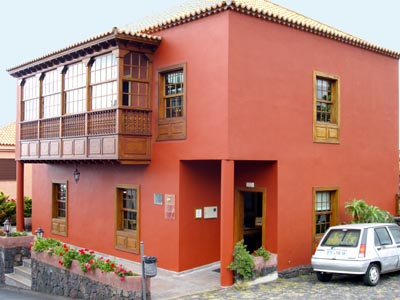
The island's wine museum stands just above La Glorieta Square.
View Larger Map

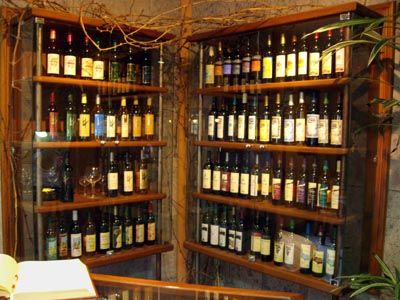
It's a small museum, but it's only 1.50€ for adults, and that includes a chance to taste a local wine or two.

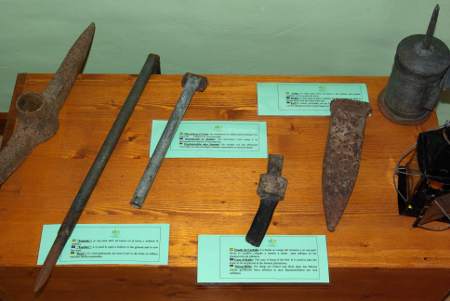
Upstairs, the exhibition explains the methods and history of wine-making on the the island, and they have a nice collection of old tools used for growing wines or making barrels

Vines have been grown on La Palma since 1505, and they had a wonderful reputation in Europe. According to the tourist office, the Malmsey wine praised by Shakespeare and his contemporaries came from La Palma, although several other places produced it too. Certainly there was no mildew on the island at the time, which must have helped. Being an island effectively kept the grapes in quarantine. But once Santa Cruz de la Palma became a major port, it was only a matter of time, and mildew arrived in the 19th century.

It ruined the grapes, and with it, the winemakers, and the local grape varieties became scarce. Things didn't really improve much until 1994 when La Palma got its "Designation of Origin", which gave local produces a standard to aim for. Now we have a wide variety of certified wines.


Why so many on such a small island?

Partly it's the variety of grapes, but mostly it's due to the micro-climates. In the wetter, northern end of the island, the vines are trained above head height to reduce the chance of mildew. In the drier south, they're trained low to the ground to stop them drying out (and harvesting them must be back-breaking work).


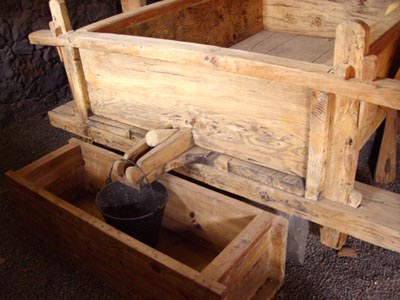
Wine press

Outside, different varieties of grape vines fill a little garden. Best of all, at the back there's a little bodega or wine house, with the original wine press.

Like most places, the grapes were taken to the local wine press. The grapes went in the open box at the top, the juice (or must) came out of the gutter and in the bucket, which is full of holes so as to strain it.


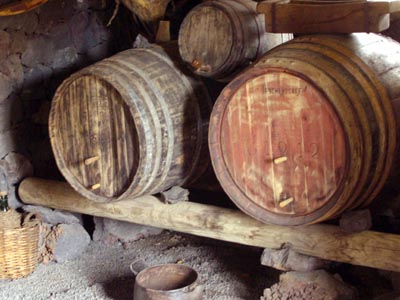
Wine barrels

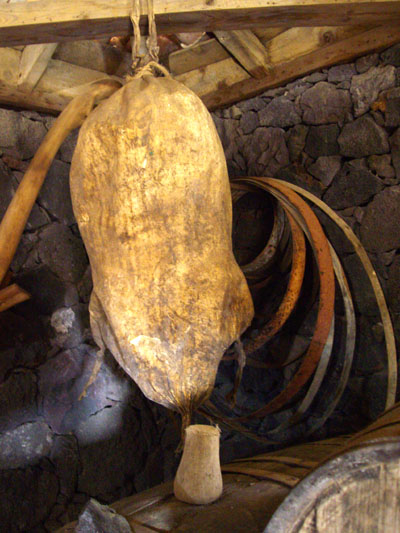
Of course the juice had to be stored in barrels until it was ready to drink. Or alternatively, in a wine skin. This one's made from the skin of a goat.


Wine skin

Labels: , , , ,

Bookmark with:

Del.icio.us Digg Reddit Facebook Furl It Newsvine StumbleUpon ToolbarStumbleUpon

Tuesday, 27 September 2011

La Glorieta Square, El Paso

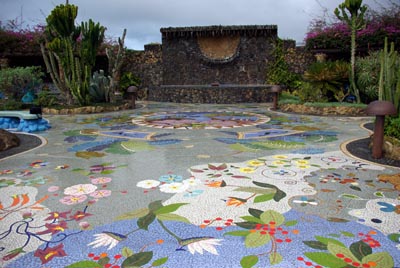
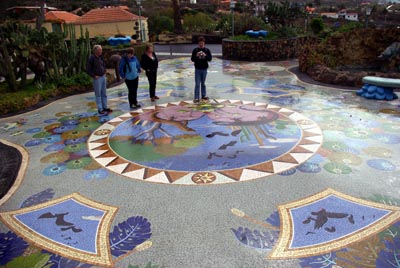
La Glorieta square: Looking north, towards the stageLooking north, towards the stage

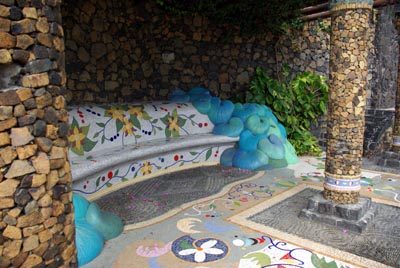
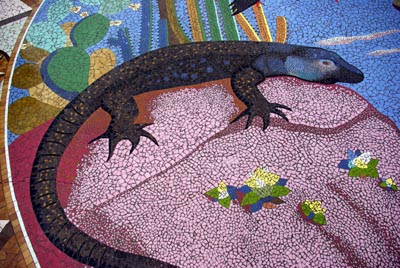
There's a lovely little square at La Glorieta. The whole floor is covered in mosaics, as are the benches. The plants are all local ones.

La Glorieta square: One of the benchesOne of the benches.

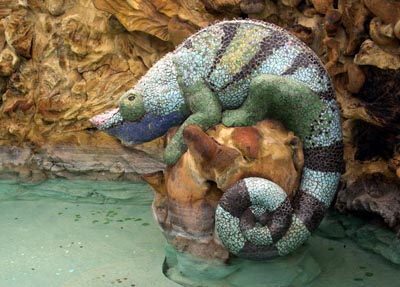
Most of the vertical walls are made from the local volcanic stone, as is the back of the little fountain of a mosaic chameleon.

La Glorieta square: The chameleon fountain.The chameleon fountain.

The whole lot was designed and made by a local artists, Luis Morerea . To get there take the road from El Paso, south towards Las Manchas. The turn off is on your right at km 40.

La Glorieta square: Detail from the central design. Detail from the central design.

Just uphill from the square you can find a village shop (good for picnic supplies) and a small wine museum. (More on the wine museum on Friday)

La Glorieta square: Looking south, from the stage.Looking south, from the stage.

Labels: , , ,

Bookmark with:

Del.icio.us Digg Reddit Facebook Furl It Newsvine StumbleUpon ToolbarStumbleUpon

Wednesday, 31 August 2011

Piscinas La Fajana, Barlovento


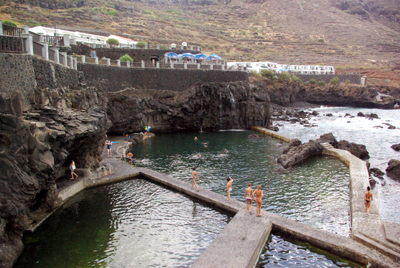
Salt water swimming pools at La Fajana, Barlovento, La Palma.

Fancy swimming in sea-water without the waves?

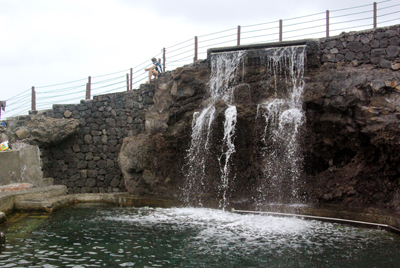
These are some rather nice salt-water swimming pools at Fajana, five km outside the village of Barlovento, on the main road to Santa Cruz. At one time they were only the natural pools, but they've been improved rather nicely. There's a pool near the top for senior citizens and the disabled, but the best places are reached down two flights of steps. They come in different depths, so that some are ideal for nervous beginners and some have more space. There's lots of flat space for sunbathing, and some caves beside the pools provide space for those who want to read a book without getting burned.

Salt water swimming pools at La Fajana, Barlovento, La Palma.

There's a cafe/bar/restaurant. It costs a bit more than similar places on the islands, but then they've obviously made a considerable investment by providing the pools. You aren't allowed to take your own food down to the pools.

You can stay in the self-catering apartments (visible at the top of the first picture) Tel 922 186162.
There are also fresh water showers (50 cents) and toilets.

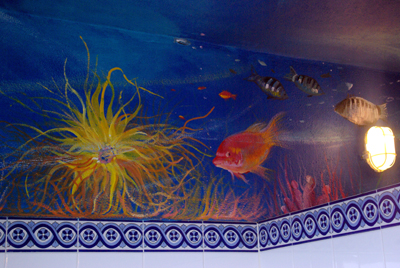
And would you believe it, the toilets/changing rooms have a lovely mural on the ceiling and the tops of the walls. ! It's signed by the local artist, Luis Morera.

The toilets at the salt water swimming pools at La Fajana, Barlovento, La Palma.

Labels: , , , , , ,

Bookmark with:

Del.icio.us Digg Reddit Facebook Furl It Newsvine StumbleUpon ToolbarStumbleUpon

Saturday, 27 August 2011

The William Herschel Telescope


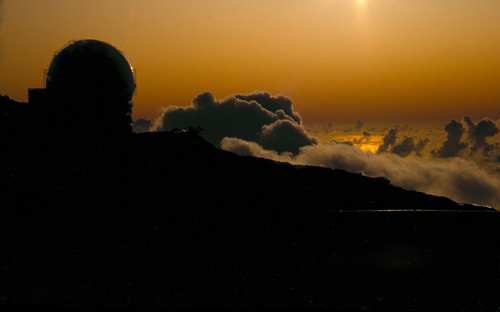
The William Herschel Telescope at sunset
The William Herschel Telescope at sunset.

The William Herschel Telescope was for many years the biggest and best optical telescope in Europe (until GranTeCan opened in 2009). The main mirror is 4.2 m across (165", or 13' 9") which astronomers call "a good light bucket". It's rather old as world-class telescopes go, since it opened in 1987, but it still produced excellent science. In fact data from the WHT has been used for about 1,500 scientific papers. It helps that it's been fitted with adaptive optics.

This is when you use some starlight to measure the air turbulence, and then deform a special, flexible mirror to compensate for that turbulence. It's rather like using glasses to correct for the shape of your eyeball, but these glasses change shape 100 times a second.

This only works if you have a bright star handy, in order to measure the turbulence in the first place. Some parts of the sky have far more stars than others, so the WHT has a laser, which can be used to create an artificial star. To the best of my knowledge, it's the only one working in Europe (although GranTeCan will have one too.)

The telescope's named after Frederick William Herschel, who was born in Germany but emigrated to England. He started life as a musician, but music lead to mathematics and then to astronomy. He's best known for discovering the planet Uranus, but he also measured the height of the mountains on the moon, discovered double stars, catalogued loads of nebulas, found two of Saturn's moons and two of Uranus's moons, and was the first to realise that the solar system is moving around the galaxy. Oh, and he discovered infra-red radiation.

Pretty impressive for someone who didn't really get started on astronomy until his mid-forties. (Obviously there's hope for me yet.)

If you want to visit the WHT, you have to sign up in advance for a visit with the IAC. Details at: http://www.iac.es/eno.php?op1=2&op2=420&lang=en

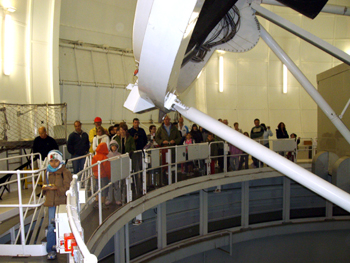
Inside the William Herschel Telescope
Inside the William Herschel Telescope, beside the secondary mirror.

Labels: , , , , ,

Bookmark with:

Del.icio.us Digg Reddit Facebook Furl It Newsvine StumbleUpon ToolbarStumbleUpon

Monday, 11 April 2011

Belmaco Cave, the Royal Palace in Mazo

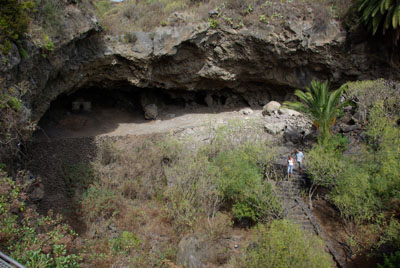
Belmaco Cave, where the kings of Mazo used to liveBelmaco cave, Mazo

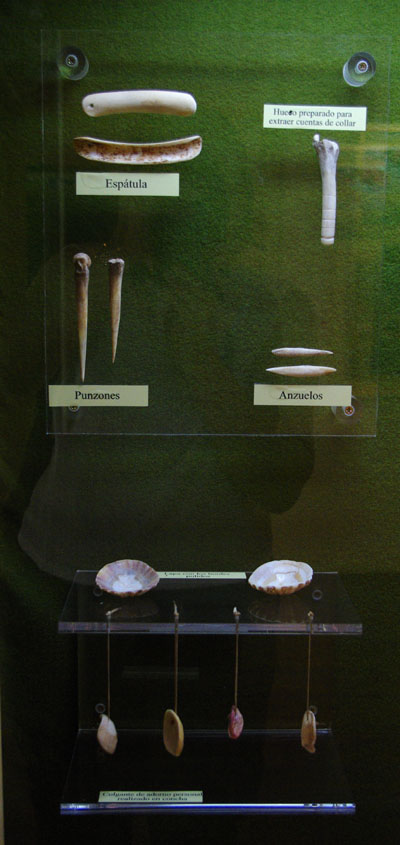
Before the Spanish invasion, Belmaco Cave was the home of the kings of Mazo. The first rock carvings were found in the 18th century, which was the start of archaeology in the Canary Islands. Today, it's open to the public. The entrance where you pay (€1.50 for a resident adult) is also a handicraft shop. A little farther inside, there's a small, two-story building housing various artefacts, like shell spoons and bone punches, and lots of ceramics. Ceramics survive better than leather work, after all.


Benhoarita artifacts, Belmaco cave, MazoBenahorita artefacts, Belmaco museum

After that you follow the path under the road to the main cave, with its rock carvings. By the way, that little square construction inside the cave is much more recent. It's an oven for drying figs.

There's a path around the site, with nine more small caves and display boards explaining things like which kind of tree is in front of you, and what it used to be used for. It's a nice stroll of about a kilometre, but in some places the paths are steep and rough, so it's not suitable if you have serious trouble walking.

There's a legend associated with the cave. The old canton of Tigalate (now Mazo) was ruled by two brothers, Juguiro and Garehagua. Their sister, Arecida, was beautiful and charming, and she fell in love with a brave and handsome warrior called Tinamarcín. Of course princesses couldn't usually marry for love, but her brothers thought well of Tinamarcín too, and so they started to prepare for the wedding of the year. All the island's royalty was expected to come.

And then Guillen Peraza arrived at the head of a party of would-be invaders. Luckily for the Benahoita, he was inexperienced, and they drove him off to LA Gomera. Tinamarcín was particularly brave and skilful in the battle, and Arecida loved him more than ever.

But Guillen Peraza came back just a few months later, and this time he brought people from La Gomera and El Hierro with him. They worked as interpreters,and fought alongside the Spanish. One of them, Jacomar from El Hierro, was dazzled by Arecida's beauty. But he was a cruel man, and when he found that she would never give him her love, he tried to take it by force. She resisted him, and he murdered her with his knife.

Tinamarcín swore vengance, but Juguiro and Garehagua got to Jacomar first. They killed him and left his body for the vultures, and Tinamarcín was left with nothing more than memories of his love.

The cave is on the lower road from Mazo towards Fuencaliente, at km 7, near Lomo Oscuro. It opens Monday - Saturday 10:00 am - 18:00 pm and Sundays 10:00 am - 14:00 pm, Tel. / Fax: 922.44.00.90 (but I'm not sure how well they speak English).

They have a website in Spanish here with a map.

Did you know that I have a Google map for La Palma? Go to http://maps.google.com/ and search for "la palma canary islands". So far, I've marked 24 places of interest.


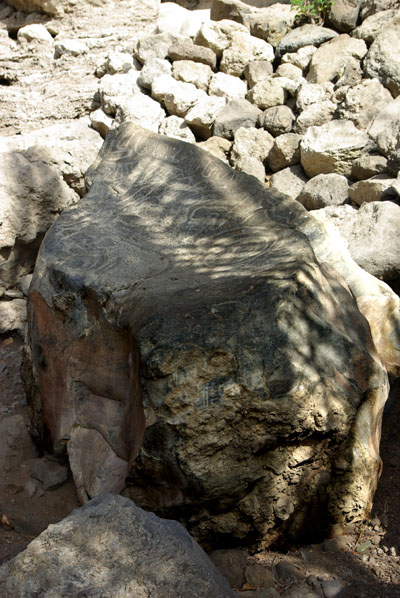
Prehispanic rock  engraving in front of the main cave, Belmaco, MazoPrehispanic rock engraving in front of the main cave, Belmaco

Labels: , , , , ,

Bookmark with:

Del.icio.us Digg Reddit Facebook Furl It Newsvine StumbleUpon ToolbarStumbleUpon

Saturday, 2 April 2011

Markets tomorrow in La Palma

 Santa Cruz de la Palma's Flea MarketFlea Market, Santa Cruz de la Palma

Santa Cruz Flea Market
Tomorrow the monthly flea market will be held in the port car park at Santa Cruz de la Palma. There’s an amazing variety of stuff on sale. For some reason there are lots of flowers, plants and vegetables, but also various crafts and antiques.


Argual Flea Market, Los Llanos

The flea market in Argual, just outside Los Llanos, takes place every Sunday from about 10 am to about 2 pm. It’s smaller than the monthly market in Santa Cruz, but it’s a much nicer situation. I think it’s been a market square for a very long time. At any rate, it’s surrounded by beautiful old buildings and has trees growing in the middle (which must be really nice on the hottest days).

This market has a slightly different flavour to Santa Cruz. It has a much higher percentage of German Hippies selling New Age things like Tibetan singing bowls.

I only saw two stalls setting plants. One also sold vegetables, and I bought some really good broccoli, plus sage and dill for the garden.

And one man was selling Palmeran cigars. Now I don’t smoke, but I believe Palmeran tobacco has a very good reputation.

Last time I went, my favourite bit was the dreamy live music. The instrument on the left is a digeridoo and the instrument on the right is a hang

Labels: , , ,

Bookmark with:

Del.icio.us Digg Reddit Facebook Furl It Newsvine StumbleUpon ToolbarStumbleUpon

Tuesday, 29 March 2011

Twin Dragon Trees in Breña Alta

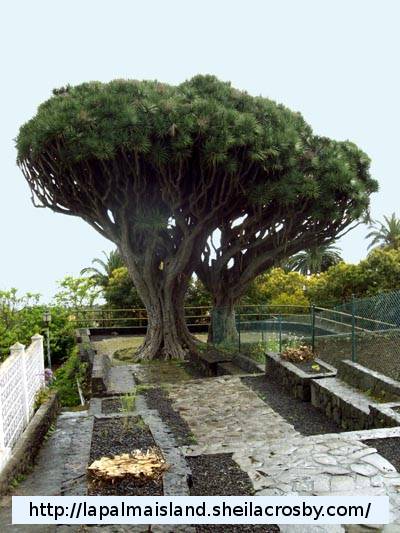
Twin dragon trees, Breña Alta, La Palma
Twin dragon trees (Dracaena draco), Breña Alta

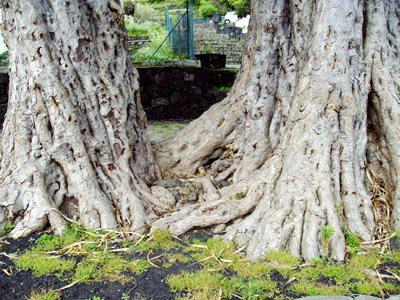
These trees stand in Breña Alta, just off the minor road which winds over the central ridge to El Paso. They grow so close together that it's hard to tell where on trunk ends and the other begins.

Trunks of twin dragon trees, Breña Alta, La Palma

Of course there's a legend associated with the trees. Two brothers lived nearby, and were very close, but they fell in love with the same gorgeous girl.

Oh dear. You can already tell that this doesn't have a happy ending, can't you?

The girl was fond of them both, but she had the sense not to keep them dangling. She chose one, and they were married, but as they walked to their new home in the dark, the spurned brother attacked. He killed the new bridegroom, and tried to rape his sister-in-law. She got to the kitchen knife first, so that was the end of him.

The new widow honoured them both by planting these two dragon trees. As the cuttings grew, she watered them and they grew tall from the fertile soil and her warm memories. They say that the brothers' blood still flows within their trunks and gives them life.

Twin dragon trees, Breña Alta, La Palma
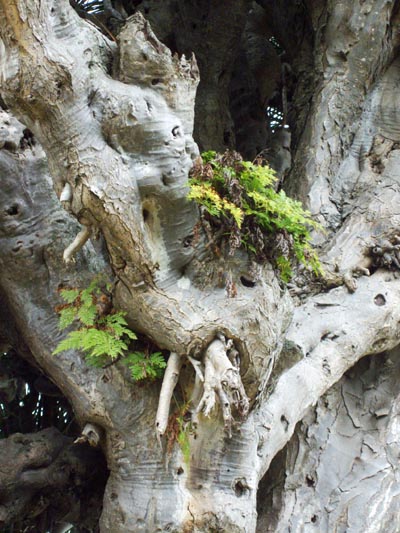
Dragon trees are odd plants (see Dragon trees). Like most mature dragon trees, these are so full of nooks and crannies that they're more a micro-climate than a plant.

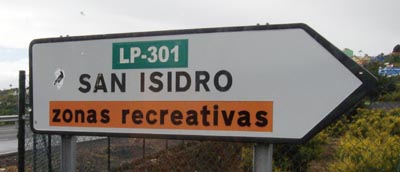
To see the trees, take the LP 123 between San Pedro and Monte de la Breña, and then the LP 301 up the hill. The trees are on the left, about 400 m from the junction. There's a tiny car park.
Twin dragon trees, Breña Alta, La Palma

Labels: , , , , , , , , ,

Bookmark with:

Del.icio.us Digg Reddit Facebook Furl It Newsvine StumbleUpon ToolbarStumbleUpon

Tuesday, 15 March 2011

The Caldera de Taburiente

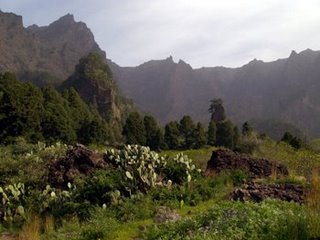
View inside the Caldera de TaburienteView inside the Caldera de Taburiente

Most people say La Palma is the most beautiful of the Canary Islands. And practically everybody agrees that the most beautiful part of La Palma is the Caldera de Taburiente.

In 1825, the German geologist Leopold von Buch studied the Caldera de Taburiente and concluded that the crater was formed by the emptying of a magma chamber below. He was sufficiently impressed with it that he gave the name “caldera” to all such formations. (See http://en.wikipedia.org/wiki/Caldera). Mauna Loa, on Hawaii, has a caldera. Olympus Mons, on Mars, has a caldera.

And the Caldera de Taburiente isn’t a caldera! Von Buch got it wrong. It looks like a caldera, but it was actually formed by erosion.

However I formed, the Caldera is impressive. It’s 5 miles (8 km) across, and most of the rim walls are almost 6,000 ft (1,800 m) above the floor. I’ve heard several people say that it looks bigger than the Grand Canyon, because your brain can just about cope with the size of the Caldera, and it just gives up with the Grand Canyon.

The geology is spectacular, but the most special thing about the Caldera is the water. The Taburiente is the only year-round river in the Canary Islands. True, a lot of water is taken out for irrigation, so that in summer the “estuary” is reduced to an underground trickle. But, except in the driest summers, you can hike all day without a water bottle, just drinking from the streams as you cross them. (But take an empty water bottle unless you’re pretty flexible. It’s a lot easier to fill the bottle and then drink, than to get both hands down to the water.) That means lush vegetation in the lower parts, even willow trees.

Most of the Caldera (18.3 square miles, or 46.9 km2) became a National Park in 1954.

More photos to follow soon.

Labels: , , ,

Bookmark with:

Del.icio.us Digg Reddit Facebook Furl It Newsvine StumbleUpon ToolbarStumbleUpon

Tuesday, 22 February 2011

Sopas de miel

Sopas de miel - bread and molasses
This is a traditional recipe for Carnival in the Canary Islands. A literal translation would be “honey soup” but as you can see, this isn’t soup. It can be rather soggy, though.

I believe in some places they use honey, but on La Palma, it’s always “miel de cana”, which is like black treacle or molasses, but a little runnier.

Ingredients
Molasses (one small jar)
1 tsp cinnamon
anis 1 desertspoon
peel of one lemon
300g of toasted almonds (chopped)
Stale bread roll (standard Canarian size) cut into slices.

Some people like to use day-old bread, for soft “sopas” Others use week-old bread, so that it’s crunchier.

Put the molasses, lemon peel, anis and cinnamon in a pan and simmer. When the flavours have had chance to mix, add about half the almonds. Keep the mixture simmering, while you add the bread slices, one at a time. Make sure they’re well soaked with the mixture, and then fish them out onto a serving dish. When you’ve done all the bread (or run out of molasses mixture) sprinkle the rest of the almonds over, to decorate.

Personally I find them far too sweet, but there you go.

Labels: , , , ,

Bookmark with:

Del.icio.us Digg Reddit Facebook Furl It Newsvine StumbleUpon ToolbarStumbleUpon

Monday, 20 December 2010

The Christmas Road Train

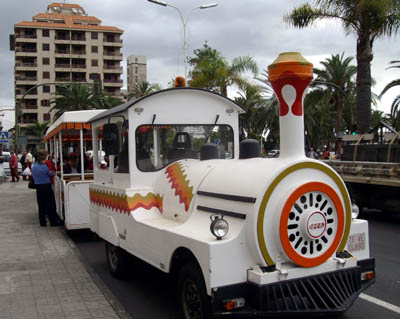
Road train, Santa Cruz de la Palma

If you were shopping in Santa Cruz last week, you might have seen a road train full of infants, grinning and waving, and shouting out "¡Feliz Navidad!"

The road train belongs to the local bus company. It's available for hire all year, but it seems to be pretty solidly booked in the last week of school term.

The school where I used to work had a regular routine. We put Father Christmas hats on the kids (a fun way to make them easy to spot in a crowd) and loaded them onto the train. First a short drive into town, waving and yelling "Merry Christmas" at everyone in sight. Then we got off and went down the main street into the square, where we had a group photo taken. We carried along the main street towards the post office, with the kids handing out hand-coloured cards along the way. It was great to see random shoppers and tourists forget their tired feet and beam as a four-year-old pressed a wrinkled bit of paper on them.

Father Christmas / Santa Claus is a very new introduction to Spain. These days he does turn up for most kids and leaves a few sweets, but the main presents arrive with the Three Kings on January 6th. So when we got to the post-office, the kids posted their letters to the kings, (the first time some of them had posted a letter) and we got back on the road train for a drive down to the next village along the coast, which is the tourist beach.
Well it was great. Bemused tourists waved, and workmen digging a ditch cheered, and passing cars (and one bulldozer!) honked their horns in salute. I felt like the queen, although I knew most of it was for the kids.
But I couldn't help feeling sorry for the occasional adults who just glared. All religion apart, if you can't raise the tiniest twitch of a smile or wave for sixty-odd kids grinning at you, then I think you're sad in every sense of the word.

Labels: , , ,

Bookmark with:

Del.icio.us Digg Reddit Facebook Furl It Newsvine StumbleUpon ToolbarStumbleUpon

Thursday, 9 December 2010

The Tsunami Risk

You may remember the fuss in 2001 when two geologists, Steven Ward and Simon Day, announced their theory that the west side of the island of La Palma would collapse one day, creating a mega-tsunami that would cross the entire Atlantic and still be anything up to 25 metres high when it hit New York, and indeed everything from Newfoundland in Canada to Recife in Brazil.

These days, almost all geologists seem to disagree.

Certainly there is a fault line, and some movement has been detected, but the fault appears to be 4 km long, not 25 km. There is no evidence that it's 2 km deep, so any landslide would be superficial and might not happen all at once. There's a volcano, but it's comparatively small. And there's a lot of water inside the island, but if the volcano erupts and turns it to steam, it has lots and lots of escape routes through the porous lava. Therefore it won't push the rock into a landslide.

The tsunami that did such awful damage in December 2004 was caused by an earthquake along 1,000 km of sea bed. If a landslide does happen on La Palma, it couldn't possibly be longer than 25 km, so the tsunami will weaken as it spreads out. You'd hardly get a splash the other side of the Atlantic.

By the way, the research was paid for by an American insurance company. And it wasn't published in a peer-reviewed journal, which means that other scientists didn't get chance to give opinions before it was broadcast.

My opinion? It's a load of hype.

You can read more at: http://www.lapalma-tsunami.com/tsunami.html
and http://www.iberianature.com/material/megatsunami.html

Labels: , , , ,

Bookmark with:

Del.icio.us Digg Reddit Facebook Furl It Newsvine StumbleUpon ToolbarStumbleUpon

Friday, 19 November 2010

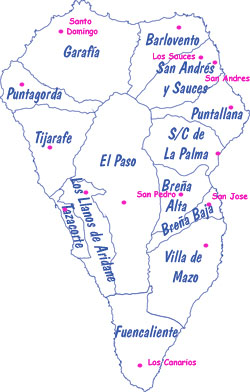
Where's the Village Gone?

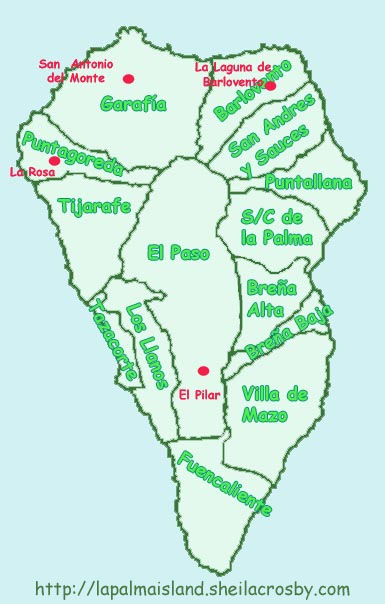
Map of La Palma municipalities

Tourists sometimes go nuts trying to find the village of Breña Baja, or Fuencaliente.

There's a really simple reason why they can't find them. They don't exist. Breña Baja and Fuencaliente are municipalities, and their town halls are in the villages of San Jose and Los Canarios, respectively. It like driving all over the south east of England, looking for the town of Sussex.

The map shows the 14 municipalities (in blue) , with their administrative seats (in pink). Where
there's no name in pink, the municipalities are named after their chief villages, which makes things simpler. Just to keep things interesting, one, San Andrés y Sauces, is named after the two biggest villages. The town hall is in Los Sauces, which is much bigger and on the main road.

That's easy to find.

Labels: , , , , , , , , , , , , , , ,

Bookmark with:

Del.icio.us Digg Reddit Facebook Furl It Newsvine StumbleUpon ToolbarStumbleUpon

Thursday, 28 October 2010

Wild Flowers of the Canary Islands


My father was a professional botanist, and he went into ecstasies over the wild flowers on La Palma. He was even fascinated by the roadside weeds. You see, because it's an island, the plants evolved in isolation, and in many cases the plant on La Palma is a different sub-species from the plant in neighbouring Tenerife. For example, echium wildipretti is a very tall cone of tiny flowers. The sub-species on La Palma has blue flowers, but the one on Tenerife has pink ones.

Anyone keen on plants will want a book to identify them. This was my father's favourite. The catch is that it was published in 1974 and it's out of print, but Amazon currently has a couple of second hand copies of this edition.

I'll be quite honest. If you buy through this link, I get a small commission, but it doesn't cost you any more.

Labels: , , , , ,

Bookmark with:

Del.icio.us Digg Reddit Facebook Furl It Newsvine StumbleUpon ToolbarStumbleUpon

Wednesday, 8 September 2010

The Devil in Tijarafe

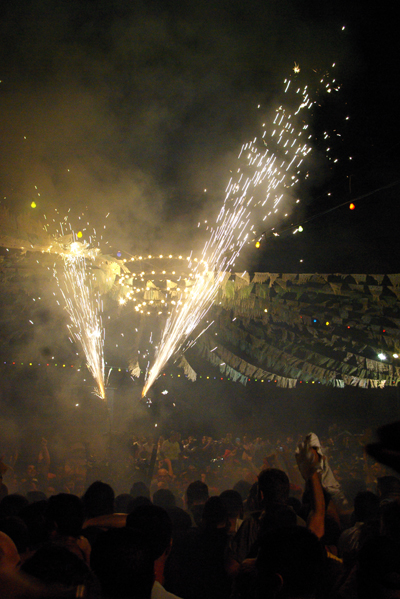
The devil's fiesta at Tijarafe, La Palma islandThe devil's fiesta at Tijarafe

Drat! I missed the fiesta del diabolo in Tijarafe.

Every year, right in the middle of the annual village fiesta, the devil turns up at Tijarafe in the early hours of September 8th.

It starts off like most fiestas. The village centre is off the main road, and on the way in, you pass the usual mobile bars, blasting out music at full volume. In the main square, higher up, people dance to the salsa band.

Something I always notice at Palmeran fiestas - a lot of the younger people are pretty drunk, but it's very rare to see a fight. In fact I don't think I saw as much as a rude gesture last year.

Finally, at about 3:30 am, the giants and big heads appeared. These are standard carnival characters, and they wouldn't excite adults normally, but they're a sign that the devil will appear any minute.

The band launches into the traditional song, which goes something like, "Tra-la-la-la, the devil's coming soon." And then, sure enough, he appears.

The Devil's dance, Tijarafe, 2007.

It's a man wearing a metal suit covered with lit fireworks, and he heads straight for the middle of the crowd. Most of the jet is directed upwards, and I don't think you'd get serious burns if you got too close, but most people try to get away. (I wouldn't wear your best clothes to this fiesta. I really wouldn't.) Of course some people farther away try to get closer, so the result is a lot of pushing and shoving. (Don't take small children either!)

Meanwhile the band is singing, "Tra-la-la-la, the devil's here now," and "Tra-la-la-la, the party's not over yet."

After about five to ten minutes of this chaos, the devil runs out of fireworks and goes away. The Virgin Mary's defeated him again! And then the crowd thins out pretty rapidly as people go home. Boring normality is restored for another year.

The devil's fiesta at Tijarafe, La Palma islandThe devil's fiesta at Tijarafe

Labels: , , , , , ,

Bookmark with:

Del.icio.us Digg Reddit Facebook Furl It Newsvine StumbleUpon ToolbarStumbleUpon

Friday, 26 March 2010

The Tazacorte Martyrs

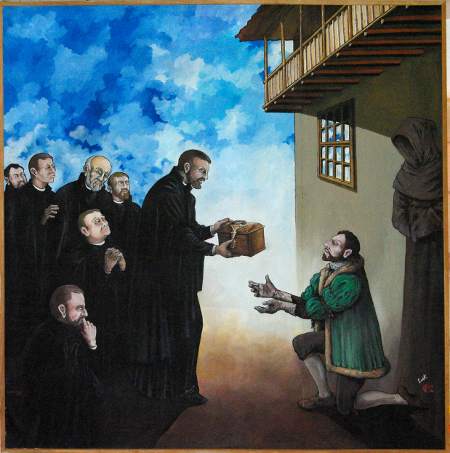
The Tazacorte Martyrs: Father Acevedo gives the relics to Don Melchor.Father Acevedo gives the relics to Don Melchor.

In 1570, a party of Jesuit missionaries were on their way from Portugal to Brazil. They broke their journey in Puerto de Tazacorte. It was an unplanned stop: they'd been heading for Santa Cruz de la Palma, but the winds were against them.

On arrival in Tazacorte, Fr. Acevedo was amazed to find that the owner of the estate was an old friend from Oporto, don Melchor de Monteverde y Pruss. Don Melchor invited the priest to stay, and the priest gave him a small chest of relics.


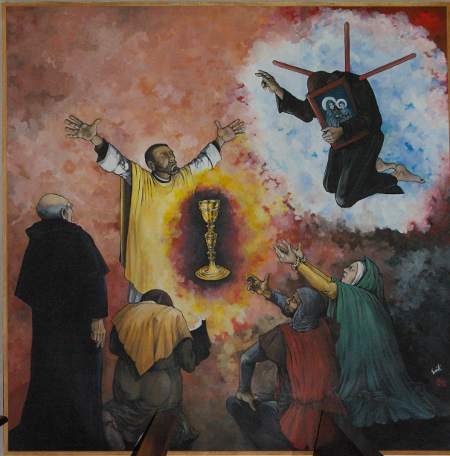
The Tazacorte Martyrs: Father Acevedo has a vision of his impending martyrdomFather Acevedo has a vision of his impending martyrdom

Fr. Acevedo said mass in the chapel of Our Lady of Anguish (Nuestra Senñora de Angustias). As he raised the chalice, he had a vision of impending martyrdom, and bit the chalice. His teeth marks are still on it.

Once in Tazacorte, they discussed the possibility of travelling to Santa Cruz over land, but decided to sail instead, in spite of the rumours of pirates in the area. I think this says a lot about the footpaths at the time.


The Tazacorte Martyrs: The missionaries meet the piratesThe missionaries meet the pirates

On July, 15th, they set sail for Santa Cruz, but the wind was still against them, and they made slow progress. Two days later they saw sails, which turned out to be boats belonging to a French pirate, Jacques Sourie.

Sourie had his men search the ship for anyone wearing a black cassock. Some were killed outright, and others had their arms hacked off before they were thrown into the sea to drown. John Sánchez was the only survivor, and only because the pirates needed a cook. So he cooked for them until they got back to La Rochelle, in France, where he escaped and made his way back to Portugal to tell the gruesome tale.

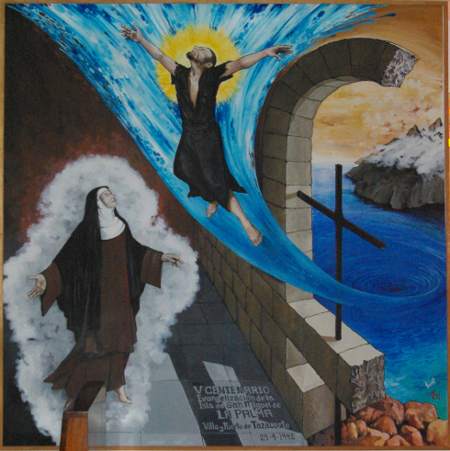
The martyr's relics are preserved in the church of San Miguel and in the the chapel of Nuestra Señora de Las Angustias. These paintings are on display in Tazacorte church.

The Tazacorte Martyrs: The Martyrs go to heavenThe Martyrs go to heaven

Labels: , ,

Bookmark with:

Del.icio.us Digg Reddit Facebook Furl It Newsvine StumbleUpon ToolbarStumbleUpon

Sunday, 21 March 2010

Palmeran Sow Thistles (Sonchus palmensis)

Sonchus palmensis

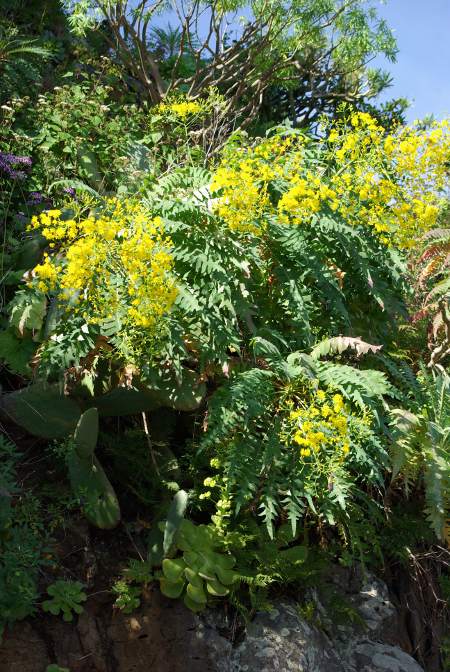
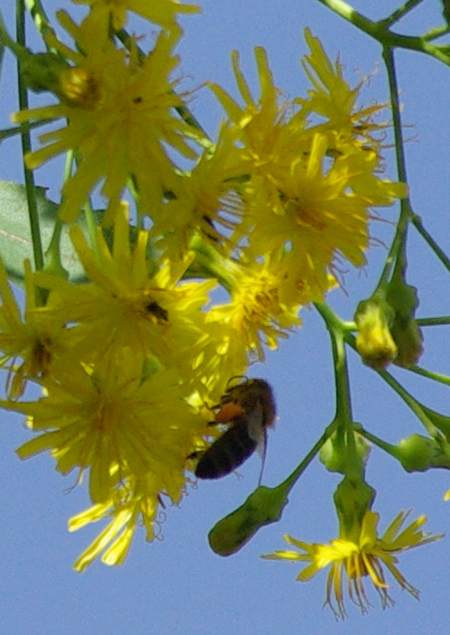
Sow thistles look rather like a dandelion gone balistic. That is, the individual flowers look much like dandelions, but they're growing on a shrub anything up to 2 m (6 ft) tall. And now they're flowing all over the island, especially on the east, up to about 1,000 ft. Like so many other plants here, La Palma has a different species from everywhere else - Sonchus palmensis.

The local names are cerraja or lechuguilla.

Sonchus palmensis closeup

Labels: , , ,

Bookmark with:

Del.icio.us Digg Reddit Facebook Furl It Newsvine StumbleUpon ToolbarStumbleUpon

Tuesday, 16 March 2010

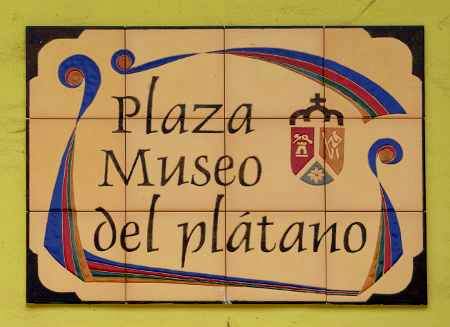
The Banana Museum, Tazacorte


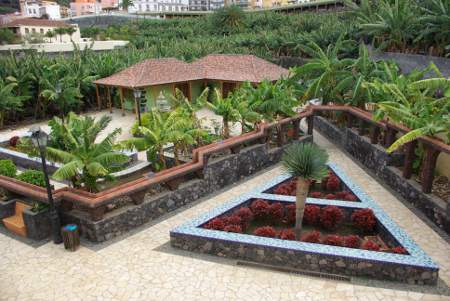
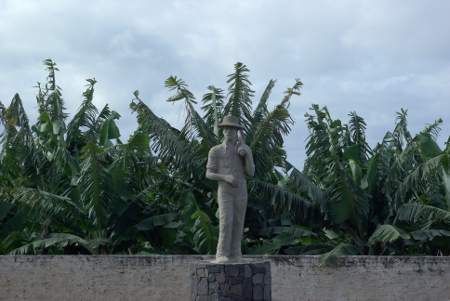
When I first heard there was a banana museum in Tazacorte, I laughed. But since about 40% of La Palma's population works works in the banana industry (growing, packing shipping etc.) it makes sense. Besides, bananas are the 4th most important crop in the world, (after rice, wheat and maize), and this is the only museum about European bananas in the world.


The museum contains lots of information panels in English and Spanish, all about thing like the origins and history of bananas, how they're grown, their health benefits, and the geology and history of Tazacorte. There's also a good selection of tools used for growing bananas.


Open Monday- Friday, 11 am - 1:30 pm
(Groups of visitors 10 am - 14:30 pm, but only by prior arrangement - Tel 922 480151)

To find the museum, first find the church then head downhill. The lane meanders through some lovely old houses, but if you follow your nose whenever there isn't a sign, you'll find it - the building's yellowy-green. And you can't beat the entrance price - it's free.

Beside the banana museum stands a mojo museum, almost ready to open. (Mojo is sort-of Canarian ketchup.) I gather the hold up is mostly paperwork, because they want to make mojo on the premises. That would make it far more interesting, of course, but the paperwork for anything to do with food is far more complicated.

The soon-to-be Mojo Museum next door

Labels: , , , ,

Bookmark with:

Del.icio.us Digg Reddit Facebook Furl It Newsvine StumbleUpon ToolbarStumbleUpon

Saturday, 13 March 2010

The Octopus's Funeral, Los Cancajos

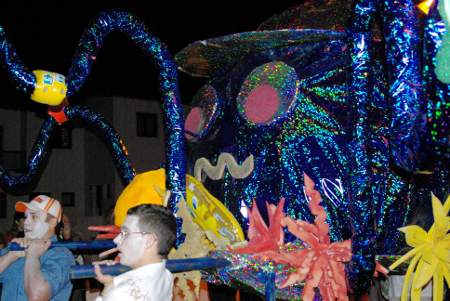
The octopus's funeral procession, Los Cancajos, Breña Baja, La PalmaThe octopus's funeral procession

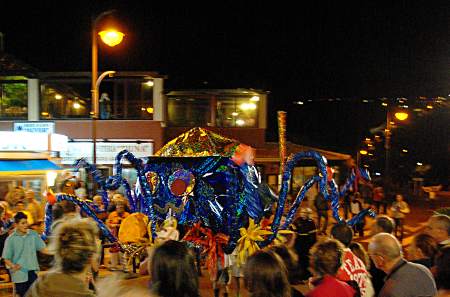
Most places in Spain end Carnival with a mock funeral for a sardine. Los Cancajos decided to have a few carnival events this year, ending in an Octopus's funeral (just for a change).

Close up of the octopus, Los Cancajos, Breña Baja, La PalmaClose up of the octopus

But the weather was terrible, and they postponed it for two weeks. And when the new date came around, there weather was terrible again, and they had to postpone it again!

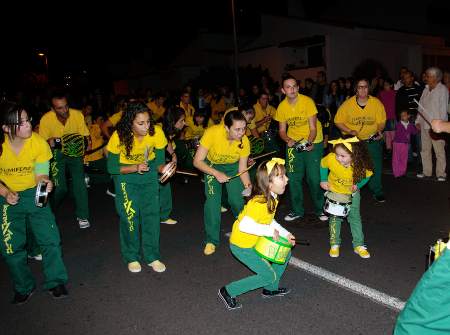
The percussion band for the Octopus's Funeral, Los Cancajos, Breña Baja, La PalmaThe percussion band

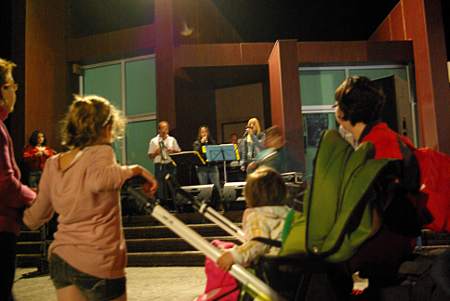
Third time lucky - the funeral went ahead last night. A percussion band (a batucada) provided the music.

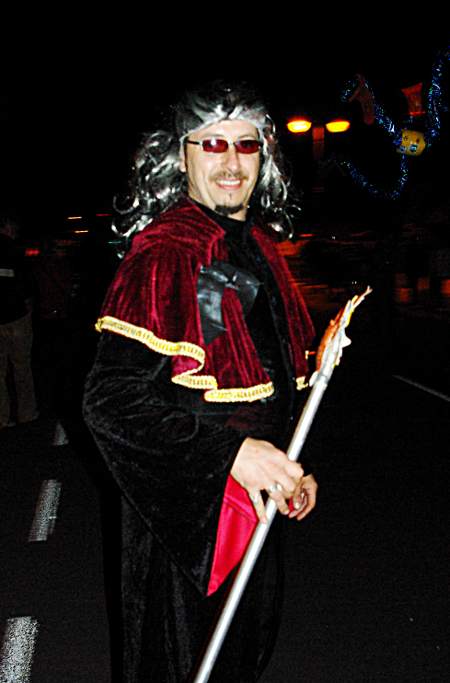
The Master of Ceremonies for the octopus's funeral, Los Cancajos, Breña Baja, La PalmaThe Master of Ceremonies

The master of ceremonies, looked rather fine as he led the way, keeping the octopus and band together.
The octopus's cremation, Los Cancajos, Breña Baja, La Palma

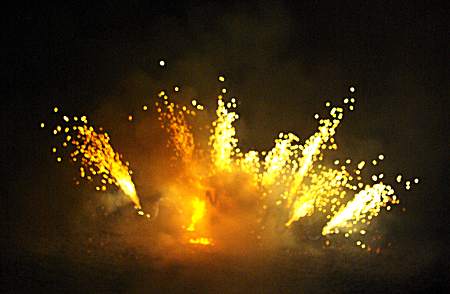
The procession went through the village and down to the beach, where they cremated it and let off the fireworks.


Fireworks at the octopus's funeral, Los Cancajos, Breña Baja, La Palma


We left, just as the band was starting up for the public dance. It was great fun, and I'm sure they'll do it again next year.

The band for the octopus's funeral, Los Cancajos, Breña Baja, La PalmaThe band

Labels: , , , ,

Bookmark with:

Del.icio.us Digg Reddit Facebook Furl It Newsvine StumbleUpon ToolbarStumbleUpon

Tuesday, 9 March 2010

Fiestas in Breña Baja


Los Cancajos
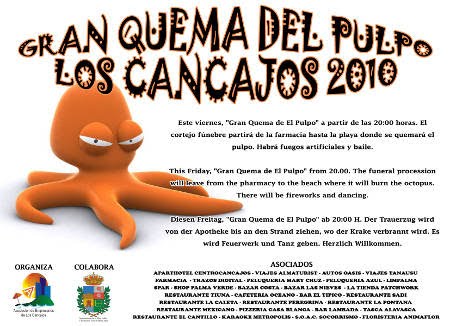
They'll be having yet another attempt to cremate the octopus in Los Cancajos on Friday 12th, starting at 8pm. This was supposed to happen during Carnival, but it's been postponed twice due to bad weather. The town hall assures everyone that the octopus won't have gone smelly, because it's been frozen during the wait.
[This is a joke. I'm sure it isn't a real octopus.]
Anyway, the procession will leave at 8 pm from the chemist's near the south end of the village.

San José
Spain celebrates Father's Day on March 19th, because that's St Joseph's day. Since the Spanish for St Joseph is San José, the village of San José will hold fiestas, starting on Friday 12th at 5 pm. There will be various sporting events and talks, an exhibition of oil paintings which opens on Monday evening, and films (in Spanish) . There'll be a special mass on Friday evening (the 19th) and on Saturday there's a hike, bouncy castles and a horse race. In the evening, there's batucada (serious percussion) a stage performance by the kids, and a disco.

Labels: , , , , ,

Bookmark with:

Del.icio.us Digg Reddit Facebook Furl It Newsvine StumbleUpon ToolbarStumbleUpon