A small rock in the Atlantic

All about the island of La Palma, in the Canaries.

Click for La Palma, Canary Islands Forecast

Sunday, 18 September 2011

Moving Mirrors at the Roque de los Muchachos

Putting the Galileo mirror onto the lorry 
Carefully putting the 6-tonne Galileo mirror onto the lorry

The big telescopes at the observatory at the Roque de Los Muchachos mostly use mirrors rather than lenses. Domestic mirrors have the aluminium behind glass to protect it, but astronomical mirrors have the aluminium on top. This gives the best image, but it also means that the aluminium slowly spoils, and has to be replaced every three years or so.

This is not simple. The aluminium layer is only about 1/10,000 th of a millimetre thick, which is about 1/100th the thickness of the thinnest human hair - the sort that grows on a baby's cheeks. So taking off the old layer is fairly easy - they just have to be very, very careful not to scratch the layer underneath. 

The really clever bit is getting the new layer to be absolutely even. Paint brushes won't do! The mirror is carefully cleaned and put into a very clean tank. Once all the air has been pumped out, the engineers send an electric current through a small aluminium fuse at the top of the tank, which vaporises in the vacuum. The aluminium vapour settles on everything. A few grammes falls onto the mirror, forming a new coating. Once the aluminium coating has formed, it takes 12 hours to let the air back into the tank, and the mirror is ready to put back on the telescope.

 But there are only two vacuum tanks in the observatory. One is in the Grantecan building, and it's used for segments of the Grantecan mirror. The other is in the William Herschel telescope building, since the WHT has the largest single-piece mirror in Europe. So the other telescopes send their mirrors to the WHT.

It's a ticklish operation. The Italian National Telescope, (also known as the Galileo) sent their mirrors to the WHT last week. The main mirror weighs 6 tonnes, and the reflective surface is delicate, so moving it onto a lorry is not simple. Once the mirror has been loaded, the road is closed and the lorry moves at walking speed. The road will be closed again on Monday and Tuesday while the mirrors come back.

The lorry with the Telescopio Nazionale Galileo mirror arriving at the William Herschel Telescope
The TNG mirror arriving at the WHT

Labels: , ,

Bookmark with:

Del.icio.us Digg Reddit Facebook Furl It Newsvine StumbleUpon ToolbarStumbleUpon

Thursday, 15 September 2011

Working on the GranTeCan dome


Working on the massive dome shutter of GranTeCan

GranTeCan is the biggest optical telescope in the world, and it's hard to convey the sheer size of it in a photograph.  The telescope itself weighs 485 tonnes.  You could fit an tennis court inside the dome, and the top of the dome is 41 m above the ground.  But you can't see any of that in a photograph.

Working on the massive dome shutter of GranTeCan, Roque de los Muchachos Observatory, La Palma
Working on the massive dome shutter of GranTeCan


Luckily for me, the engineers did some maintenance on the massive dome recently. Once you have people in the photograph, you get an idea of the size.

GranTeCan, the Big Canarian Telescope

Labels: , , ,

Bookmark with:

Del.icio.us Digg Reddit Facebook Furl It Newsvine StumbleUpon ToolbarStumbleUpon

Saturday, 27 August 2011

The William Herschel Telescope


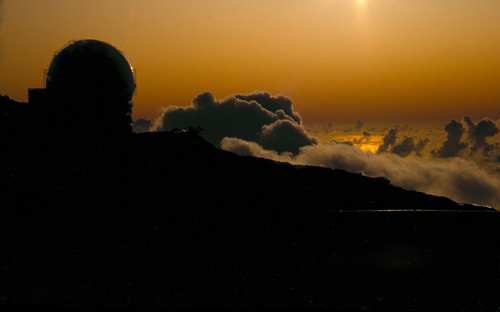
The William Herschel Telescope at sunset
The William Herschel Telescope at sunset.

The William Herschel Telescope was for many years the biggest and best optical telescope in Europe (until GranTeCan opened in 2009). The main mirror is 4.2 m across (165", or 13' 9") which astronomers call "a good light bucket". It's rather old as world-class telescopes go, since it opened in 1987, but it still produced excellent science. In fact data from the WHT has been used for about 1,500 scientific papers. It helps that it's been fitted with adaptive optics.

This is when you use some starlight to measure the air turbulence, and then deform a special, flexible mirror to compensate for that turbulence. It's rather like using glasses to correct for the shape of your eyeball, but these glasses change shape 100 times a second.

This only works if you have a bright star handy, in order to measure the turbulence in the first place. Some parts of the sky have far more stars than others, so the WHT has a laser, which can be used to create an artificial star. To the best of my knowledge, it's the only one working in Europe (although GranTeCan will have one too.)

The telescope's named after Frederick William Herschel, who was born in Germany but emigrated to England. He started life as a musician, but music lead to mathematics and then to astronomy. He's best known for discovering the planet Uranus, but he also measured the height of the mountains on the moon, discovered double stars, catalogued loads of nebulas, found two of Saturn's moons and two of Uranus's moons, and was the first to realise that the solar system is moving around the galaxy. Oh, and he discovered infra-red radiation.

Pretty impressive for someone who didn't really get started on astronomy until his mid-forties. (Obviously there's hope for me yet.)

If you want to visit the WHT, you have to sign up in advance for a visit with the IAC. Details at: http://www.iac.es/eno.php?op1=2&op2=420&lang=en

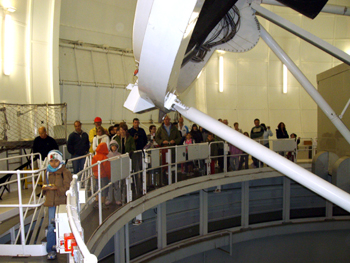
Inside the William Herschel Telescope
Inside the William Herschel Telescope, beside the secondary mirror.

Labels: , , , , ,

Bookmark with:

Del.icio.us Digg Reddit Facebook Furl It Newsvine StumbleUpon ToolbarStumbleUpon

Tuesday, 23 August 2011

Terrific time-lapse video of La Palma

Enjoy Christoph Malin's wonderful time-lapse video of La Palma. He very nearly does the place justice.

Labels: ,

Bookmark with:

Del.icio.us Digg Reddit Facebook Furl It Newsvine StumbleUpon ToolbarStumbleUpon

Friday, 12 August 2011

Events on La Palma this weekend

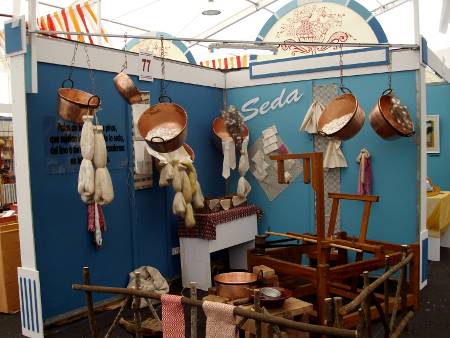
Silk exhibition at last year's craft fair

Friday night is the best meteor shower of the year, the Perseids. Of course it should be visible all over the planet, but La Palma's astronomical viewpoints will probably be a particularly good place to see shooting stars. Unfotunately the full moon will spoil the show quite a bit. Astrotour will be in La Polvacera bsketball court from 9 pm - 11:30 pm with telescopes.

This year, the island's annual craft fair will be in San Pedro, Breña Alta, from yesterday until Tuesday. There are 179 different exhibitors, showing 40 different crafts, so there should be something for everybody. The fair is in a big marquee in the Parque los Alamos just north of San Pedro, beside the tobacco museum. It will be open from 5 pm to 9 pm Friday, Saturday and Wednesday, and 11 am - 9 pm on Sunday and Monday.

Puntagorda is celebrating its annual fiesta, of St Maurus the Abbot. On Saturday there's a romería (something between a religious procession and a party) from the village centre to the old church, followed by a special mass, shared picnic and dance.

There are other fiestas in Concepción, Fuencaliente, Barlovento, and Argual.

Monday is a national holiday, and most shops will be shut, although most food shops will open at least briefly.

Labels: , ,

Bookmark with:

Del.icio.us Digg Reddit Facebook Furl It Newsvine StumbleUpon ToolbarStumbleUpon

Tuesday, 26 July 2011

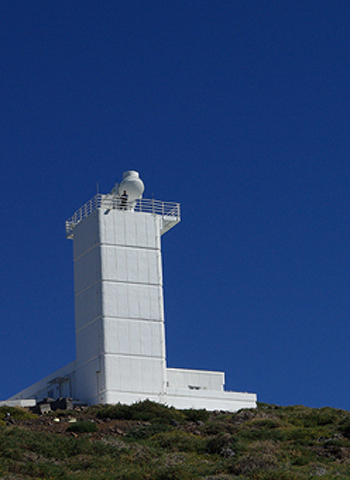
The Swedish Solar Telescope


Two of the fourteen telescopes at the Roque de los Muchachos observatory are solar telescopes -- highly specialised to observe our own sun. This is the Swedish Solar Telescope, which was the first telescope built on the Roque. It's currently the best solar telescope in the world since they added the new adaptive optics in 2005. (Adaptive optics compensate for air turbulence.) It can resolve details of the sun's surface only 70km across.

Whereas most telescopes struggle to collect enough light, the main design problem for solar telescopes is air turbulence caused by heat. They solved this by making most of the tower a vacuum tube. Of course that means that the 1 metre lens at the top of the tower has to be very strong to cope with the pressure difference, as well as optically perfect.

The rounded thingamybob on the top of the tower behind the man is called a heliostat: it follows the sun across the sky and sends the image down the tower to the instruments in the basement.

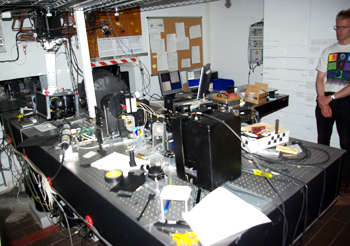
And here is the basement. At the top left you can see the bottom of circle where the sunlight comes down, together with some of the copper water pipes for cooling it. The light is then split up: some goes to the adaptive optics and most to a series of cameras, each of which observes a different wavelength.


They observe things like sunspots, which are areas of the sun's surface where an intense magnetic field interferes with convection, and keeps the temperature to a mere 4000 ºC, instead of 5800 ºC like the rest. Each spot may be several times the size of the Earth.

The telescope is not open to visitors. If you want more details, the telescope's home page is here

Labels: , , , ,

Bookmark with:

Del.icio.us Digg Reddit Facebook Furl It Newsvine StumbleUpon ToolbarStumbleUpon

Wednesday, 22 June 2011

STARMUS on La Palma

Grantecan, the biggest optical telescope in the world, at sunset
STARMUS is a unique scientific, artistic and musical event taking place mostly in Tenerife this week, with a truely stellar lineup of speakers and performers. I wanted to go, but I couldn't afford the time or the money.

I say "mostly in Tenerife" because on Thursday Jack Szostak, Brian May, Richard Dawkins, Kip Thorne, George Smoot, Jill Tarter, Alexei Leonov and Neil Armstrong are coming to the Roque de los Muchachos for a round table discussion in the GTC dome at 7 pm. They'll be talking about things like: Why do we want to go to space? Why do we need to study the Universe? What are the relative merits of manned versus robotic space missions? Where do we go next?

It will be webcast live at http://www.starmus.com/pages/en/broadcast.php

Labels: , ,

Bookmark with:

Del.icio.us Digg Reddit Facebook Furl It Newsvine StumbleUpon ToolbarStumbleUpon

Thursday, 16 June 2011

Blood red moon over La Palma

Total eclipse of the moon from Llano de la Venta viewpointA Blood red eclipse of the moon from Llano de la Venta viewpoint

Last night, La Palma saw a total eclipse of the moon. Well, a large part of planet Earth saw it, of course, but since La Palma has beautiful dark skies, we saw it better than most places. In fact La Palma has a set of viewpoints upgraded for astronomy. In practice, this means parking space, level ground suitable for tripods, a signpost pointing to the pole star, and an information panel.

Signpost to the  Pole Star, Breña Alta, La Palma.How far to the Pole Star?

I went up to Llano de la Venta viewpoint, where Astrotour was offering free stargazing, courtesy of the island government. These viewpoints can be pretty cold in winter - this one is at 1,300 m - but last night it was quite balmy. We got a splendid view of the moon, followed by a splendid view of the International Space Station zooming overhead. (Every time they add more solar panels, the ISS gets brighter and brighter). And to round things off nicely, Astrotour pointed their 10" telescope at Saturn, so we could all see the rings.

You could say it was a heavenly evening.

The International  Space Station passing over La Palma, seen from Breña AltaThe International Space Station passing over Breña Baja

Labels: ,

Bookmark with:

Del.icio.us Digg Reddit Facebook Furl It Newsvine StumbleUpon ToolbarStumbleUpon

Friday, 22 April 2011

G Astronomy in La Palma

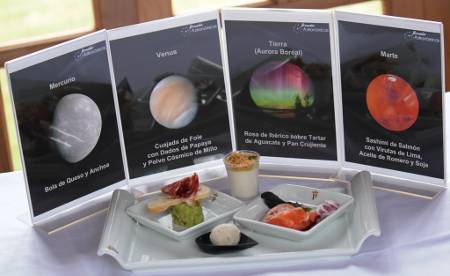
Dishes inspired by Mercury, Venus, Earth and Mars, served at the Parador, La Palma island.Dishes inspired by Mercury, Venus, Earth and Mars.

The Parador on La Palma is just outside the village of San Jose, in Breña Baja. (Paradors are a national chain of posh hotels, and very nice they are too.) Tonight (April 22nd ) at 8 pm they'll be hosting the first public dinner with a new menu, inspired by astronomical bodies. A professional Starlight guide will be there to talk about the planets, and afterwards, there will be stargazing.

I haven't tried these dishes myself, but people who have tell me they taste heavenly.

Cost: 40€ per person. Reservations are essential, since numbers will be limited. For more information and bookings, phone 922 43 58 28 or email lapalma@parador.es

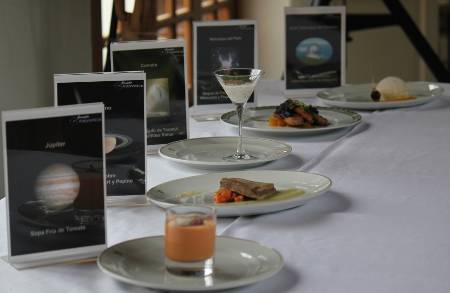
Dishes inspired by Jupiter, Saturn, comets and the Grantecan telescope, Parador in La PalmaDishes inspired by Jupiter, Saturn, Neptune, comets and the Grantecan telescope.

Labels: , ,

Bookmark with:

Del.icio.us Digg Reddit Facebook Furl It Newsvine StumbleUpon ToolbarStumbleUpon

Monday, 18 April 2011

Star Party in Santa Cruz de la Palma


The castle on the hill above Santa Cruz (to the north) gets its name from the five-yearly festival where they bring the statue of the Virgin Mary down from Las Nieves into Santa Cruz. It's not much used in between fiestas, but Wednesday 20th April is The World Night in Defence of Starlight, and Astrotour will be holding a Star Party there from 9 pm to 1 am.

You'll be able to see Saturn and its rings through a telescope, watch an audiovisual presentation, and see the main constellations.

The castle is one of La Palma's network of viewpoints recommended for stargazing, and will be named after Spica, the brightest star in the constellation Virgo. Even though it's so close to the town, you can still see the brighter stars, thanks to La Palma's Sky Law. It should be an interesting night.

Labels: ,

Bookmark with:

Del.icio.us Digg Reddit Facebook Furl It Newsvine StumbleUpon ToolbarStumbleUpon

Wednesday, 27 January 2010

Star Finders

Galaxy M100 taken with the Isaac Newton Telescope and Wide Field Camera by Simon Driver.
M100 (NGC 4321), a barred galaxy in the Virgo cluster

There's a really simple reason why the Royal Greenwich Observatory moved their telescopes here. It's one of the three best places in the world for astronomy.

A modern telescope could see the equivalent of a candle on the moon, so obviously they want to be well away from city lights. Even more obviously, they want to be somewhere that doesn't get many cloudy nights.

Much less obviously, they want to be somewhere the stars don't twinkle. This happens when the air's turbulent. It's pretty, but it really messes up your view.

There are three places in the world which are great on all three counts, and La Palma is one of them. (The other two are the peak of Mauna Kea, Hawaii, and the Atacama Desert in Chile.)

The problem is to keep it that way.

When the observatory moved here, they asked for, and got, an agreement to limit things like street lights. Los Llanos has a street with lamps which remind me of 1950's hairdryers - the sort that go all around your head.

Recently the island government committed to spending over a million euros to update the streetlights to reduce the light pollution even further.

The result of all this is that La Palma is a great place for amateur astronomers, too. Even in a resort, people notice how many more stars you see here, compared to almost any English town or city. Here's another picture, this time of M51, taken by my friends in Franceses with an 80mm amateur telescope on their first night's astronomy since they moved here. Of course there's a lot of skill involved too. But they used to live in Streatham, and no amount of skill would produce that kind of result there.

If you want to recognise the constellations, the best solution is something called a planisphere. This is two special circles of plastic fastened at the centre. Twirl them until the date on one lines up with the time on the other, and you get a picture of the night sky for the right time, date, and position on the planet. (In fact you want to set the time for an hour later than GMT because clocks on La Palma are set just one hour behind Madrid, which leaves us in the same time zone as
London, but a long way west.)

If you bring a UK planisphere with you, everything will be shifted and it won't show the southern stars at all.


Perhaps surprisingly, the best one for the Canaries is titled "Hawaii, Mexico, India, Hong Kong, Taiwan." This is because you have to buy one for the correct latitude (your distance north or south of the equator) but the longitude (east-west distance from London) doesn't matter, because you compensate for that when you set the time.


Amazon.co.uk sells normally sells them for £6.99 (at left), although the last time I looked they only had a used one, (and it was more expensive). If you want a UK planisphere, it's slightly cheaper (at right).


Amazon.com also sell them. The one for La Palma is $13.87 (below)
Philips Planisphere from Amazon.com


Happy stargazing!

Labels: , , , , ,

Bookmark with:

Del.icio.us Digg Reddit Facebook Furl It Newsvine StumbleUpon ToolbarStumbleUpon

Thursday, 26 November 2009

Moon Exhibition in Santa Cruz de la Palma

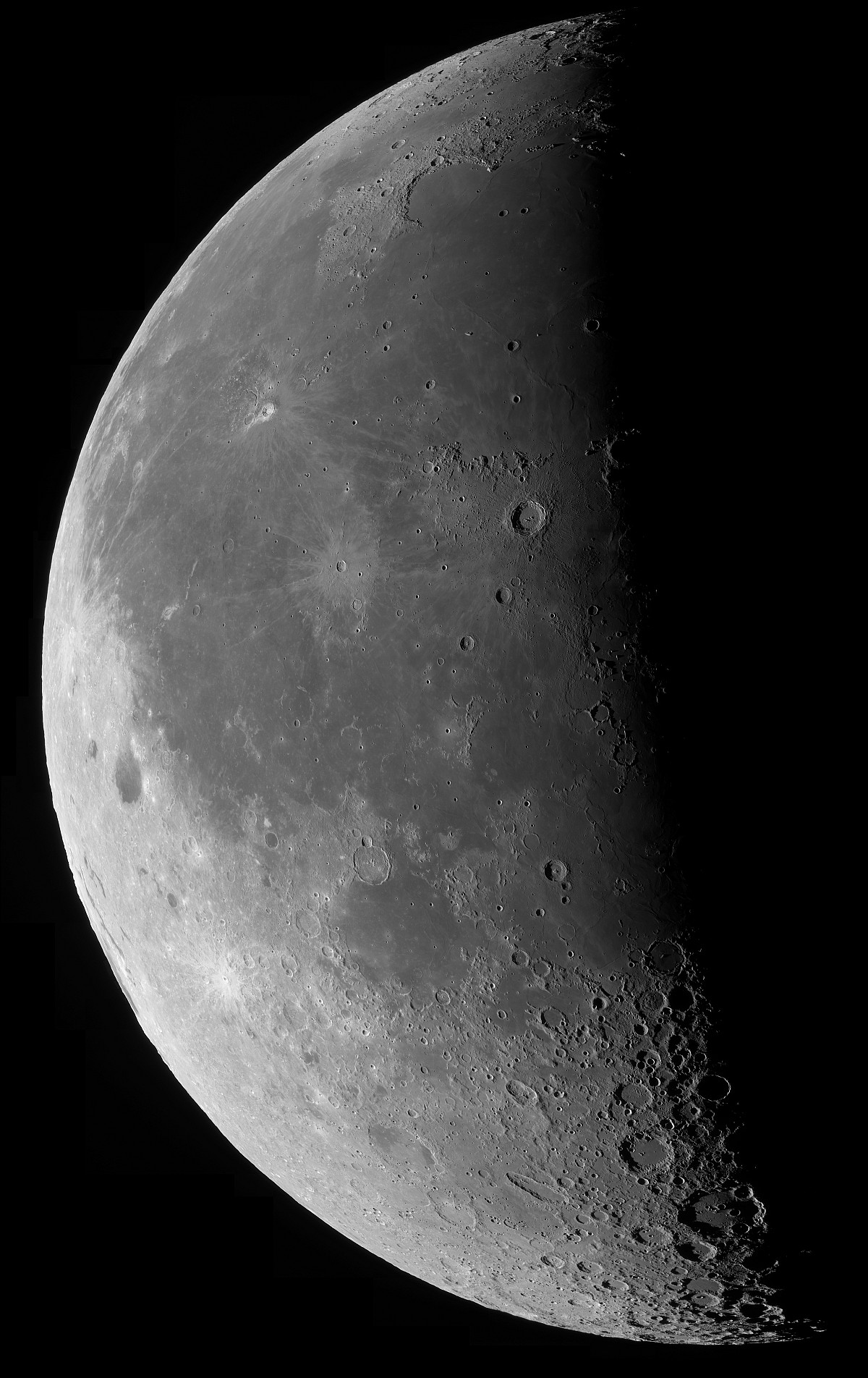
Photo of the moonPhoto: Nick Smith, taken on August 14th at the Roque de los Muchachos


In honour of the 40th anniversary of Neil Armstrong and Buzz Aldrin walking on the moon, and the International Year of Astronomy, the observatory is hosting an exhibition about the moon. It covers the history of lunar observations from the first time Galileo pointed his telescope at it in 1609 to the present. You don't have to read Spanish to appreciate the gorgeous photos from the telescopes at the Roque de los Muchachos, or the videos and interactive maps of the moon.

The opening party is on Saturday 28th November at noon. The classic rock group, Manifold, will play songs about the moon, and there will be free nibbles.

That night at 8pm there'll be telescopes in the main courtyard of the San Francisco convent so you can see the moon up close and personal. Best of all, the Italians are bringing a replica of Galileo's telescope from 400 years ago.

and for those that do understand Spanish, on Friday 4th December at 8pm, Dr. Romano Corradi of the Grantecan will give a talk on the moon.

And it's all free!

The exhibition is in Palacio Salazar, on the main street (Calle O'Daly) of Santa Cruz de la Palma, open from 10 am to 8pm. Monday, 30th November - Friday, 4th December.

Labels: ,

Bookmark with:

Del.icio.us Digg Reddit Facebook Furl It Newsvine StumbleUpon ToolbarStumbleUpon

Tuesday, 11 August 2009

Where to find the Star Parties

Here's a Google map with the locations of the two star parties, at the top and bottom.

View La Palma Island in a larger map
Click on one of the blue map pins for details.

Labels: , , ,

Bookmark with:

Del.icio.us Digg Reddit Facebook Furl It Newsvine StumbleUpon ToolbarStumbleUpon

Monday, 10 August 2009

Stargazing in aid of Fire Victims

Wednesday night (August 12th) should be the best night of the year to see shooting stars. Shooting stars happen when the Earth passes through a cloud of dust left behind by a comet's tail. To celebrate, the amateur astronomers on La Palma and Astrotour are holding two star parties.

You'll be able to observe the sun through a telescope (safely!) in Santa Cruz de la Palma in the Plaza España from 11 am to 1 pm.

And from 8 pm - 11pm there'll be nocturnal telescopes in the basketball court at La Polvacera in Breña Baja. And the residents' association will provide drinks.

In both cases, the Red Cross will be collecting for the people who lost their homes in the forest fire.

So you get astronomy and warm fuzzy feelings in one go.

Labels: , , , ,

Bookmark with:

Del.icio.us Digg Reddit Facebook Furl It Newsvine StumbleUpon ToolbarStumbleUpon

Wednesday, 15 July 2009

GRANTECAN: The big Canarian Telescope

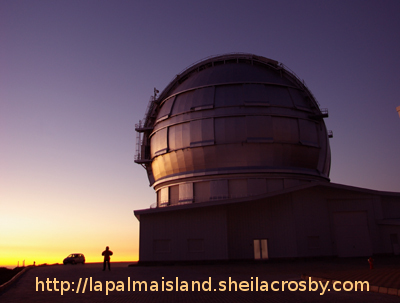
GranTeCan at sunset

This is GranTeCan (Gran Telescopio Canario / Big Canarian Telescope) on the Roque de los Muchachos observatory in La Palma. It will be inaugurated on July 24th. The king and queen of Spain are coming, and there are rumours that Dr. Brian May is coming too. The telescope and its first two instruments cost €105 million: 90% of this came from Spain, 5% from Mexico, and 5% from the University of Florida. They'll share the observing time in the same proportions.

They aren't kidding about the "big" part, as it's the biggest telescope in the world. If you took the telescope out of the dome, there'd be room for a tennis court in there. The main mirror is 10.4 metres across. For comparison, the next biggest telescope in Europe, the William Herschel Telescope, has a mirror 4.2 metres across. But while the Herschel's has one big mirror, GranTeCan has 36 hexagonal segments, each over 2 metres from point to point. They're probably the best quality optical surface in the world, too. (The special glass used for ceramic hobs was developed for astronomical mirrors. I bet you didn't know that.)

The aim of all this is to gather more light, which means that the telescope can see fainter, hence more distant objects then anyone's seen before. Since light takes time to travel, that means it's looking back in time. They don't know exactly what they'll discover. That's the whole point.

Galileo's first telescope was enough for him to see sunspots, Jupiter's moons and the phases of Venus (it waxes and wanes, like the moon) and get him into terrible, terrible trouble with the Church. All that with a telescope diameter of about 4cm.

I'm looking forward to see what Grantecan finds with an extra 10.36 metres.

Labels: , , ,

Bookmark with:

Del.icio.us Digg Reddit Facebook Furl It Newsvine StumbleUpon ToolbarStumbleUpon

Monday, 29 June 2009

Visiting the Observatory, 2009

GranTeCan, the huge new Spanish telescope

La Palma is home to one of the three most important astronomical observatories in the world. (The other two are Hawaii and the Atacama desert in Chile.) The observatory sits at the top of the island, at the Roque de los Muchachos. It's a fascinating place to visit, but it's not normally open to tourists - they're too busy doing science. You can visit the mountain top and see the buildings from the outside any day of the year. But please note:
  • Days only, not nights. The William Herschel Telescope could see a candle on the moon, and the MAGIC telescope is even more sensitive. They really don't like car headlights. Some years ago there was an incident some years ago where a bus shone its lights right at the Herschel's dome. Now there's a barrier across the road which is shut a half an hour after sunset, and raised around dawn.
  • The road to the observatory is usually blocked for a few days each winter, by snow or landslides. Use your common sense. If the sign at the bottom of the mountain road says it's blocked, don't go up. I once rescued a couple of German tourists who'd spent the night in the car in the drainage ditch, after going past the sign, thinking that the weather couldn't be all that bad in the Canaries. It can. That night it was thick fog, 60 mph winds, and -5C. Thank God they didn't try to walk, because they'd have frozen to death for sure.
Since the MAGIC gamma ray telescope doesn't have a building, you get quite a good view from the outside. You can get fairly close by parking on one of the heliports (the bottom left as you go up the hill). From there, a footpath goes closer, and there's a display panel that explains how the telescope works.

If you want to see inside, you need to go on a guided tour. In 2009 they will hold 28 open days, each with only one group. Each visit starts with a visit to the MAGIC gamma-ray telescope, followed by one other telescope, and lasts about two hours. Visits must be booked in advance, by calling the receptionist at the Institute of Astronomy on (00 34) 922 425 703. And yes, the receptionist speaks English. Book early -- the places go fast. But no children under 12 allowed.

They also hold private visits, usually for schools or visiting astronomers. You can email your request to adminorm@iac.es. I believe the person who reads the email, speaks English. To be honest, they're unlikely to organise a visit for the average tourist, but if there's a visit organised anyway, you might be able to tag along. Cross your fingers!

The MAGIC gamma-ray telescope

Labels: , , , , ,

Bookmark with:

Del.icio.us Digg Reddit Facebook Furl It Newsvine StumbleUpon ToolbarStumbleUpon

Wednesday, 8 October 2008

Asteroid strike

A small asteroid, some 3 metres in diameter, came screaming in at 12 km /s (27,000 mph) and exploded over northern Sudan at 2:45 am on Tuesday October 7th. They don't think any of the bits would have been big enough to hit the ground. This is the first time an asteroid has been spotted and tracked before impact.

And the reason it's on this blog is that the William Herschel Telescope got a spectrum of the fireball as it zipped over the CanaryIslands.

Cool!

Labels: , , , , , ,

Bookmark with:

Del.icio.us Digg Reddit Facebook Furl It Newsvine StumbleUpon ToolbarStumbleUpon

Thursday, 11 September 2008

R.I.P. Florian Goebel

Florien was the project manager for MAGIC II, the second of the huge Cherenkov telescopes at the Roque de los Muchachos. The telescope was due to be inaugurated next week, on the 19th. That's been delayed now, because somehow he fell from the prime focus tower in the dark last night. The tower is about ten metres (33ft) high, and Florien's dead.

I only ever had one conversation with him. He must have been very busy, but he took time out to help me with a magazine article. I always think that's the acid test of character: how you treat people who are of no possible use to you.

My husband worked for him for three weeks, fitting mirror segments to MAGIC II, and said several times how nice he was.

My sincere sympathies to his family.

Labels: , , , , ,

Bookmark with:

Del.icio.us Digg Reddit Facebook Furl It Newsvine StumbleUpon ToolbarStumbleUpon

Friday, 22 August 2008

Stargazing

The island's association of amateur astronomers will be holding a star party on Saturday, from 8pm, behind the trees in the plaza beside the tourist office in El Paso. There will be lots of amateur telescopes there, so you can get a good look at, say, Saturn or Jupiter, and they plan to be there until midnight. I gather they speak some English.

La Palma has amazing skies. This is a great opportunity, especially if you live in a big city where the street lights drown out the stars.

For information phone Toño Gonzalez on 607592175.

Labels: , , , ,

Bookmark with:

Del.icio.us Digg Reddit Facebook Furl It Newsvine StumbleUpon ToolbarStumbleUpon

Friday, 8 August 2008

The William Herschel Telescope

The William Herschel Telescope at sunset
The William Herschel Telescope at sunset.

The William Herschel Telescope is currently the biggest and best optical telescope in Europe (until GranTeCan opens this autumn.) The main mirror is 4.2 m across (165", or 13' 9") which astronomers call "a good light bucket". It's rather old as world-class telescopes go, since it opened in 1987, but it still produced excellent science. In fact data from the WHT has been used for about 1,500 scientific papers. It helps that it's been fitted with adaptive optics.

This is when you use some starlight to measure the air turbulence, and then deform a special, flexible mirror to compensate for that turbulence. It's rather like using glasses to correct for the shape of your eyeball, but these glasses change shape 100 times a second.

This only works if you have a bright star handy, in order to measure the turbulence in the first place. Some parts of the sky have far more stars than others, so the WHT has a laser, which can be used to create an artificial star. To the best of my knowledge, it's the only one working in Europe (although GranTeCan will have one too.)


The telescope's named after Frederick William Herschel, who was born in Germany but emigrated to England. He started life as a musician, but music lead to mathematics and then to astronomy. He's best known for discovering the planet Uranus, but he also measured the height of the mountains on the moon, discovered double stars, catalogued loads of nebulas, found two of Saturn's moons and two of Uranus's moons, and was the first to realise that the solar system is moving around the galaxy. Oh, and he discovered infra-red radiation.

Pretty impressive for someone who didn't really get started on astronomy until his mid-forties. (Obviously there's hope for me yet.)

If you want to visit the WHT, you have to sign up in advance for an open day. Details at: http://lapalmaisland.sheilacrosby.com/articles/visit_obs.php

Inside the William Herschel Telescope
Inside the William Herschel Telescope, beside the secondary mirror.

Labels: , , , , , ,

Bookmark with:

Del.icio.us Digg Reddit Facebook Furl It Newsvine StumbleUpon ToolbarStumbleUpon