A small rock in the Atlantic

All about the island of La Palma, in the Canaries.

Click for La Palma, Canary Islands Forecast

Sunday, 18 September 2011

Moving Mirrors at the Roque de los Muchachos

Putting the Galileo mirror onto the lorry 
Carefully putting the 6-tonne Galileo mirror onto the lorry

The big telescopes at the observatory at the Roque de Los Muchachos mostly use mirrors rather than lenses. Domestic mirrors have the aluminium behind glass to protect it, but astronomical mirrors have the aluminium on top. This gives the best image, but it also means that the aluminium slowly spoils, and has to be replaced every three years or so.

This is not simple. The aluminium layer is only about 1/10,000 th of a millimetre thick, which is about 1/100th the thickness of the thinnest human hair - the sort that grows on a baby's cheeks. So taking off the old layer is fairly easy - they just have to be very, very careful not to scratch the layer underneath. 

The really clever bit is getting the new layer to be absolutely even. Paint brushes won't do! The mirror is carefully cleaned and put into a very clean tank. Once all the air has been pumped out, the engineers send an electric current through a small aluminium fuse at the top of the tank, which vaporises in the vacuum. The aluminium vapour settles on everything. A few grammes falls onto the mirror, forming a new coating. Once the aluminium coating has formed, it takes 12 hours to let the air back into the tank, and the mirror is ready to put back on the telescope.

 But there are only two vacuum tanks in the observatory. One is in the Grantecan building, and it's used for segments of the Grantecan mirror. The other is in the William Herschel telescope building, since the WHT has the largest single-piece mirror in Europe. So the other telescopes send their mirrors to the WHT.

It's a ticklish operation. The Italian National Telescope, (also known as the Galileo) sent their mirrors to the WHT last week. The main mirror weighs 6 tonnes, and the reflective surface is delicate, so moving it onto a lorry is not simple. Once the mirror has been loaded, the road is closed and the lorry moves at walking speed. The road will be closed again on Monday and Tuesday while the mirrors come back.

The lorry with the Telescopio Nazionale Galileo mirror arriving at the William Herschel Telescope
The TNG mirror arriving at the WHT

Labels: , ,

Bookmark with:

Del.icio.us Digg Reddit Facebook Furl It Newsvine StumbleUpon ToolbarStumbleUpon

Thursday, 15 September 2011

Working on the GranTeCan dome


Working on the massive dome shutter of GranTeCan

GranTeCan is the biggest optical telescope in the world, and it's hard to convey the sheer size of it in a photograph.  The telescope itself weighs 485 tonnes.  You could fit an tennis court inside the dome, and the top of the dome is 41 m above the ground.  But you can't see any of that in a photograph.

Working on the massive dome shutter of GranTeCan, Roque de los Muchachos Observatory, La Palma
Working on the massive dome shutter of GranTeCan


Luckily for me, the engineers did some maintenance on the massive dome recently. Once you have people in the photograph, you get an idea of the size.

GranTeCan, the Big Canarian Telescope

Labels: , , ,

Bookmark with:

Del.icio.us Digg Reddit Facebook Furl It Newsvine StumbleUpon ToolbarStumbleUpon

Saturday, 27 August 2011

The William Herschel Telescope


The William Herschel Telescope at sunset
The William Herschel Telescope at sunset.

The William Herschel Telescope was for many years the biggest and best optical telescope in Europe (until GranTeCan opened in 2009). The main mirror is 4.2 m across (165", or 13' 9") which astronomers call "a good light bucket". It's rather old as world-class telescopes go, since it opened in 1987, but it still produced excellent science. In fact data from the WHT has been used for about 1,500 scientific papers. It helps that it's been fitted with adaptive optics.

This is when you use some starlight to measure the air turbulence, and then deform a special, flexible mirror to compensate for that turbulence. It's rather like using glasses to correct for the shape of your eyeball, but these glasses change shape 100 times a second.

This only works if you have a bright star handy, in order to measure the turbulence in the first place. Some parts of the sky have far more stars than others, so the WHT has a laser, which can be used to create an artificial star. To the best of my knowledge, it's the only one working in Europe (although GranTeCan will have one too.)

The telescope's named after Frederick William Herschel, who was born in Germany but emigrated to England. He started life as a musician, but music lead to mathematics and then to astronomy. He's best known for discovering the planet Uranus, but he also measured the height of the mountains on the moon, discovered double stars, catalogued loads of nebulas, found two of Saturn's moons and two of Uranus's moons, and was the first to realise that the solar system is moving around the galaxy. Oh, and he discovered infra-red radiation.

Pretty impressive for someone who didn't really get started on astronomy until his mid-forties. (Obviously there's hope for me yet.)

If you want to visit the WHT, you have to sign up in advance for a visit with the IAC. Details at: http://www.iac.es/eno.php?op1=2&op2=420&lang=en

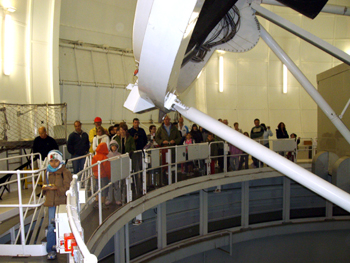
Inside the William Herschel Telescope
Inside the William Herschel Telescope, beside the secondary mirror.

Labels: , , , , ,

Bookmark with:

Del.icio.us Digg Reddit Facebook Furl It Newsvine StumbleUpon ToolbarStumbleUpon

Tuesday, 26 July 2011

The Swedish Solar Telescope


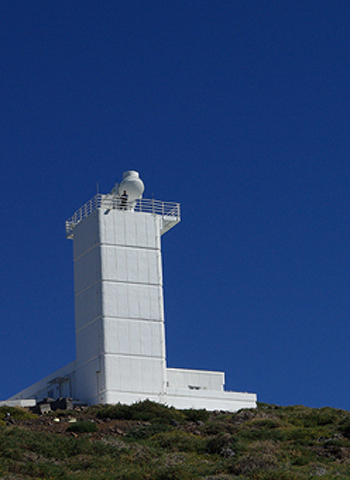
Two of the fourteen telescopes at the Roque de los Muchachos observatory are solar telescopes -- highly specialised to observe our own sun. This is the Swedish Solar Telescope, which was the first telescope built on the Roque. It's currently the best solar telescope in the world since they added the new adaptive optics in 2005. (Adaptive optics compensate for air turbulence.) It can resolve details of the sun's surface only 70km across.

Whereas most telescopes struggle to collect enough light, the main design problem for solar telescopes is air turbulence caused by heat. They solved this by making most of the tower a vacuum tube. Of course that means that the 1 metre lens at the top of the tower has to be very strong to cope with the pressure difference, as well as optically perfect.

The rounded thingamybob on the top of the tower behind the man is called a heliostat: it follows the sun across the sky and sends the image down the tower to the instruments in the basement.

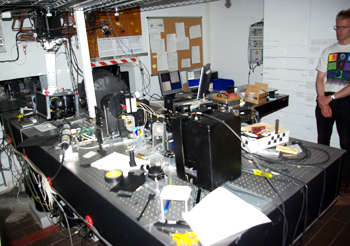
And here is the basement. At the top left you can see the bottom of circle where the sunlight comes down, together with some of the copper water pipes for cooling it. The light is then split up: some goes to the adaptive optics and most to a series of cameras, each of which observes a different wavelength.


They observe things like sunspots, which are areas of the sun's surface where an intense magnetic field interferes with convection, and keeps the temperature to a mere 4000 ºC, instead of 5800 ºC like the rest. Each spot may be several times the size of the Earth.

The telescope is not open to visitors. If you want more details, the telescope's home page is here

Labels: , , , ,

Bookmark with:

Del.icio.us Digg Reddit Facebook Furl It Newsvine StumbleUpon ToolbarStumbleUpon

Wednesday, 22 June 2011

STARMUS on La Palma

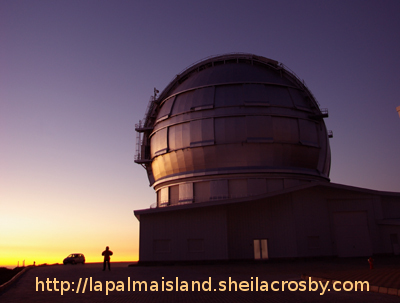
Grantecan, the biggest optical telescope in the world, at sunset
STARMUS is a unique scientific, artistic and musical event taking place mostly in Tenerife this week, with a truely stellar lineup of speakers and performers. I wanted to go, but I couldn't afford the time or the money.

I say "mostly in Tenerife" because on Thursday Jack Szostak, Brian May, Richard Dawkins, Kip Thorne, George Smoot, Jill Tarter, Alexei Leonov and Neil Armstrong are coming to the Roque de los Muchachos for a round table discussion in the GTC dome at 7 pm. They'll be talking about things like: Why do we want to go to space? Why do we need to study the Universe? What are the relative merits of manned versus robotic space missions? Where do we go next?

It will be webcast live at http://www.starmus.com/pages/en/broadcast.php

Labels: , ,

Bookmark with:

Del.icio.us Digg Reddit Facebook Furl It Newsvine StumbleUpon ToolbarStumbleUpon

Friday, 11 February 2011

Snow at the Roque de los Muchachos

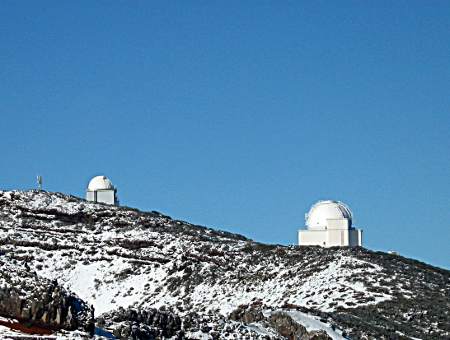
The Isaac Newton and Jacobus Kapteyn telescopes in the snow, Roque de los Muchachos observatoryThe Isaac Newton and Jacobus Kapteyn telescopes in the snow, Roque de los Muchachos observatory


The Canary Islands are known as the land of eternal spring, but that's not quite true at 2,396 metres (7,861 ft). Down at sea-level, it's been raining. Up on the mountain, it's been snowing.

Yesterday the road was only suitable for 4-wheel-drive vehicles, but I gather the road is open again. If you're on La Palma, this is your chance to make a snowman. But drive carefully, and once you get above the treeline, watch out for ice in the shadows.

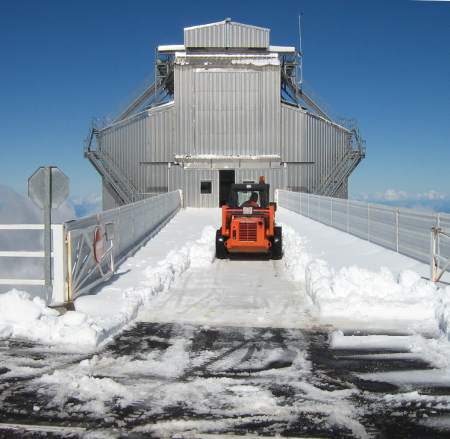
Snow removal at the Galileo telescope, Roque de los MuchachosSnow removal at the Galileo telescope, Roque de los Muchachos

Labels: , , ,

Bookmark with:

Del.icio.us Digg Reddit Facebook Furl It Newsvine StumbleUpon ToolbarStumbleUpon

Monday, 11 October 2010

Ravens on La Palma

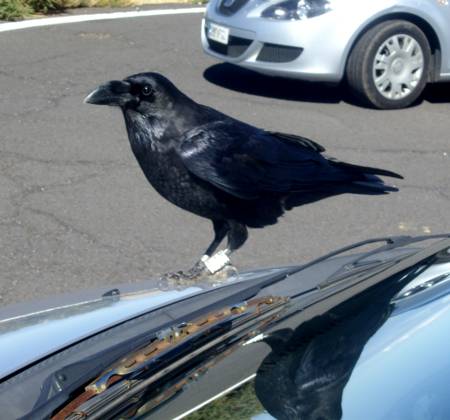
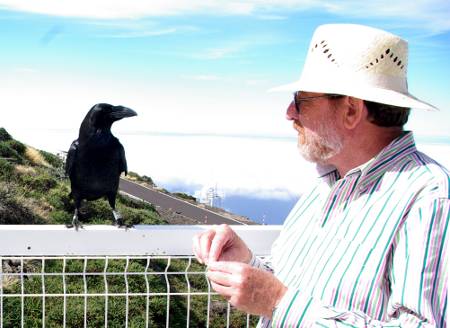
Raven on my car at the observatory, Garafía.Carmelo the raven (Corvus corax canariensis) on my car at the observatory, Garafía.

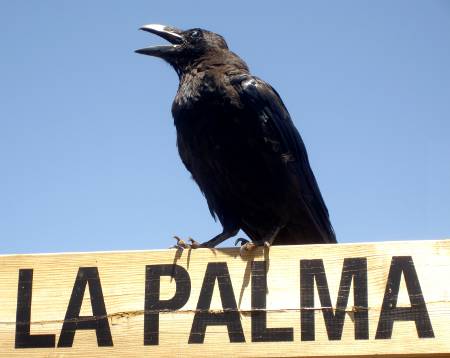
Common Ravens live all over Europe, Asia and North America, but we have a different sub-species here. Some biologists group our raven in with the North African sub-species (Corvus corax tingitanus) and others think the Canaries have their own sub-species (Corvus corax canariensis).

Like other members of the rook-and-crow family, they'll eat whatever's available: carrion, insects, cereal grains, berries, fruit, small animals, and food waste. And they're pretty intelligent about getting it. At least two individual ravens at the Roque have learned to provide a photo opportunity in exchange for some food.


Raven outside the Galileo telescope, Garafía.Raven outside the Galileo telescope, Garafía.

Carmelo hangs around the car park at the Roque itself, although I've met him at the Galileo telescope and observatory heliport. He's got a ring around one ankle. The other raven doesn't have an ankle ring, and I mostly see him near the Los Andennes viewpoint, and I call him Nevermore, after the poem "The Raven" by Edgar Allan Poe. ("Quoth the raven, `Nevermore.' ")

Nevermore, the raven (Corvus corax canariensis) at Los Andennes viewpoint, Garafía.Nevermore, the raven at Los Andennes viewpoint, Garafía.

Labels: , , ,

Bookmark with:

Del.icio.us Digg Reddit Facebook Furl It Newsvine StumbleUpon ToolbarStumbleUpon

Friday, 24 July 2009

The Inauguration of GranTeCan

The Official Inaurguration of GranTeCan

Oddly enough, nobody invited me to meet the king of Spain at the official inauguration of GranTeCan (Gran Telescopio Canario or Big Canarian Telescope) so I had to watch it on the TV.

I learned something new. The main mirror is accurate to 15 nanometres (a nanometre is a millionth of a millimetre). So if you scaled up the mirror to 10,400 km (and the radius of the Earth is 6,400 km) then the height difference between the highest mountain peak and the lowest valley would be 15mm.

Labels: , , ,

Bookmark with:

Del.icio.us Digg Reddit Facebook Furl It Newsvine StumbleUpon ToolbarStumbleUpon

Wednesday, 15 July 2009

GRANTECAN: The big Canarian Telescope

GranTeCan at sunset

This is GranTeCan (Gran Telescopio Canario / Big Canarian Telescope) on the Roque de los Muchachos observatory in La Palma. It will be inaugurated on July 24th. The king and queen of Spain are coming, and there are rumours that Dr. Brian May is coming too. The telescope and its first two instruments cost €105 million: 90% of this came from Spain, 5% from Mexico, and 5% from the University of Florida. They'll share the observing time in the same proportions.

They aren't kidding about the "big" part, as it's the biggest telescope in the world. If you took the telescope out of the dome, there'd be room for a tennis court in there. The main mirror is 10.4 metres across. For comparison, the next biggest telescope in Europe, the William Herschel Telescope, has a mirror 4.2 metres across. But while the Herschel's has one big mirror, GranTeCan has 36 hexagonal segments, each over 2 metres from point to point. They're probably the best quality optical surface in the world, too. (The special glass used for ceramic hobs was developed for astronomical mirrors. I bet you didn't know that.)

The aim of all this is to gather more light, which means that the telescope can see fainter, hence more distant objects then anyone's seen before. Since light takes time to travel, that means it's looking back in time. They don't know exactly what they'll discover. That's the whole point.

Galileo's first telescope was enough for him to see sunspots, Jupiter's moons and the phases of Venus (it waxes and wanes, like the moon) and get him into terrible, terrible trouble with the Church. All that with a telescope diameter of about 4cm.

I'm looking forward to see what Grantecan finds with an extra 10.36 metres.

Labels: , , ,

Bookmark with:

Del.icio.us Digg Reddit Facebook Furl It Newsvine StumbleUpon ToolbarStumbleUpon

Monday, 29 June 2009

Visiting the Observatory, 2009

GranTeCan, the huge new Spanish telescope

La Palma is home to one of the three most important astronomical observatories in the world. (The other two are Hawaii and the Atacama desert in Chile.) The observatory sits at the top of the island, at the Roque de los Muchachos. It's a fascinating place to visit, but it's not normally open to tourists - they're too busy doing science. You can visit the mountain top and see the buildings from the outside any day of the year. But please note:
  • Days only, not nights. The William Herschel Telescope could see a candle on the moon, and the MAGIC telescope is even more sensitive. They really don't like car headlights. Some years ago there was an incident some years ago where a bus shone its lights right at the Herschel's dome. Now there's a barrier across the road which is shut a half an hour after sunset, and raised around dawn.
  • The road to the observatory is usually blocked for a few days each winter, by snow or landslides. Use your common sense. If the sign at the bottom of the mountain road says it's blocked, don't go up. I once rescued a couple of German tourists who'd spent the night in the car in the drainage ditch, after going past the sign, thinking that the weather couldn't be all that bad in the Canaries. It can. That night it was thick fog, 60 mph winds, and -5C. Thank God they didn't try to walk, because they'd have frozen to death for sure.
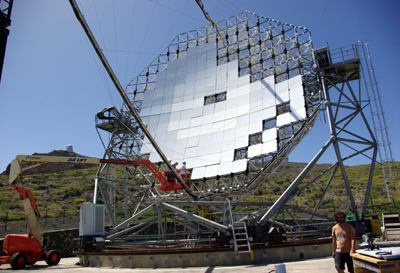
Since the MAGIC gamma ray telescope doesn't have a building, you get quite a good view from the outside. You can get fairly close by parking on one of the heliports (the bottom left as you go up the hill). From there, a footpath goes closer, and there's a display panel that explains how the telescope works.

If you want to see inside, you need to go on a guided tour. In 2009 they will hold 28 open days, each with only one group. Each visit starts with a visit to the MAGIC gamma-ray telescope, followed by one other telescope, and lasts about two hours. Visits must be booked in advance, by calling the receptionist at the Institute of Astronomy on (00 34) 922 425 703. And yes, the receptionist speaks English. Book early -- the places go fast. But no children under 12 allowed.

They also hold private visits, usually for schools or visiting astronomers. You can email your request to adminorm@iac.es. I believe the person who reads the email, speaks English. To be honest, they're unlikely to organise a visit for the average tourist, but if there's a visit organised anyway, you might be able to tag along. Cross your fingers!

The MAGIC gamma-ray telescope

Labels: , , , , ,

Bookmark with:

Del.icio.us Digg Reddit Facebook Furl It Newsvine StumbleUpon ToolbarStumbleUpon

Tuesday, 3 March 2009

Road to the Roque Blocked

The road from Santa Cruz to the Roque is blocked by snow at least until midday tomorrow. It's open on the Garafía side, but only to 4-wheel drive vehicles.

Years ago, when I was on duty overnight at the Roque in winter, it was part of my job to check the road in the morning to see whether or not it was safe for cars to come up to site. One morning, I found two German tourists who had driven past the "road closed" sign, ignored all the snow and ice they could see out of the car windows ("It can't be really bad. We're in the Canaries!") and kept going until they slid into the ditch at the side of the road and couldn't get out.

They'd spent the whole night there, turning on the engine every now and then to run the heater, and they were very pleased to see me.

So I very seriously suggest that you don't try and get to the Roque in a normal car at the moment. Hypothermia could really spoil your holiday.

Labels: , ,

Bookmark with:

Del.icio.us Digg Reddit Facebook Furl It Newsvine StumbleUpon ToolbarStumbleUpon

Tuesday, 10 February 2009

Rock slide

Most of the snow has melted, and the road from Santa Cruz to the observatory is open again. But there's a landslide blocking half the road above the treeline, somewhere near the rock formation that looks like a red submarine.

Labels: , ,

Bookmark with:

Del.icio.us Digg Reddit Facebook Furl It Newsvine StumbleUpon ToolbarStumbleUpon

Friday, 6 February 2009

The Isaac Newton Telescope in the snow

La Palma has a lovely sub-tropical climate. It's called the land of eternal spring. But today the top of the mountain is covered with snow.

Of course, we only ever get snow at high altitude, and these days, we don't get snow every winter. But when it snows, it can dump several feet in one night.

The Roque is one of the three best sites in the world for astronomy, so there's a major international observatory up there. Of course, they expect occasional snow, so they're geared up for it. They have 4x4 vehicles, and in winter they carry snow chains and shovels, just in case. Unless it's cloudy, they carry right on observing. The snow plough was busy this morning, getting the road open again.

The photo at the top is the Isaac Newton Telescope, looking Christmassy, taken last year.

And this is the the MAGIC telescope this evening, taken with their webcam at http://www.magic.iac.es/webcams/index.html
MAGIC telescope in the snow

Labels: , , ,

Bookmark with:

Del.icio.us Digg Reddit Facebook Furl It Newsvine StumbleUpon ToolbarStumbleUpon

Wednesday, 8 October 2008

Asteroid strike

A small asteroid, some 3 metres in diameter, came screaming in at 12 km /s (27,000 mph) and exploded over northern Sudan at 2:45 am on Tuesday October 7th. They don't think any of the bits would have been big enough to hit the ground. This is the first time an asteroid has been spotted and tracked before impact.

And the reason it's on this blog is that the William Herschel Telescope got a spectrum of the fireball as it zipped over the CanaryIslands.

Cool!

Labels: , , , , , ,

Bookmark with:

Del.icio.us Digg Reddit Facebook Furl It Newsvine StumbleUpon ToolbarStumbleUpon

Friday, 19 September 2008

The other Princess

No, not the Princess hotel, although I've heard that's very nice.

Princess Maha Chakri Sirindhorn from Thailand visited La Palma on Monday, and stayed the night. In the morning, she inaugurated the
Siam Park in Tenerife, which will be the biggest aquatic theme park in Europe when in opens. Then she came to La Palma and visited the observatory, where she visited the huge new Spanish telescope GranTeCan (Gran Telescopio Canario, Big Canarian Telescope) and the William Herschel Telescope. She also saw observing at the Herschel, and with some amateur astronomers from the island, and then stayed the night. On Tuesday morning, I saw the convoy coming down the mountain road as I drove up to work as a tour guide.

According to wikipedia, her royal highness is known for her interest in applying science and technology to Thailand's development. I'm told she seemed to thoroughly enjoy her visit.

Labels: , , , , ,

Bookmark with:

Del.icio.us Digg Reddit Facebook Furl It Newsvine StumbleUpon ToolbarStumbleUpon

Thursday, 11 September 2008

R.I.P. Florian Goebel

Florien was the project manager for MAGIC II, the second of the huge Cherenkov telescopes at the Roque de los Muchachos. The telescope was due to be inaugurated next week, on the 19th. That's been delayed now, because somehow he fell from the prime focus tower in the dark last night. The tower is about ten metres (33ft) high, and Florien's dead.

I only ever had one conversation with him. He must have been very busy, but he took time out to help me with a magazine article. I always think that's the acid test of character: how you treat people who are of no possible use to you.

My husband worked for him for three weeks, fitting mirror segments to MAGIC II, and said several times how nice he was.

My sincere sympathies to his family.

Labels: , , , , ,

Bookmark with:

Del.icio.us Digg Reddit Facebook Furl It Newsvine StumbleUpon ToolbarStumbleUpon

Friday, 8 August 2008

The William Herschel Telescope

The William Herschel Telescope at sunset
The William Herschel Telescope at sunset.

The William Herschel Telescope is currently the biggest and best optical telescope in Europe (until GranTeCan opens this autumn.) The main mirror is 4.2 m across (165", or 13' 9") which astronomers call "a good light bucket". It's rather old as world-class telescopes go, since it opened in 1987, but it still produced excellent science. In fact data from the WHT has been used for about 1,500 scientific papers. It helps that it's been fitted with adaptive optics.

This is when you use some starlight to measure the air turbulence, and then deform a special, flexible mirror to compensate for that turbulence. It's rather like using glasses to correct for the shape of your eyeball, but these glasses change shape 100 times a second.

This only works if you have a bright star handy, in order to measure the turbulence in the first place. Some parts of the sky have far more stars than others, so the WHT has a laser, which can be used to create an artificial star. To the best of my knowledge, it's the only one working in Europe (although GranTeCan will have one too.)


The telescope's named after Frederick William Herschel, who was born in Germany but emigrated to England. He started life as a musician, but music lead to mathematics and then to astronomy. He's best known for discovering the planet Uranus, but he also measured the height of the mountains on the moon, discovered double stars, catalogued loads of nebulas, found two of Saturn's moons and two of Uranus's moons, and was the first to realise that the solar system is moving around the galaxy. Oh, and he discovered infra-red radiation.

Pretty impressive for someone who didn't really get started on astronomy until his mid-forties. (Obviously there's hope for me yet.)

If you want to visit the WHT, you have to sign up in advance for an open day. Details at: http://lapalmaisland.sheilacrosby.com/articles/visit_obs.php

Inside the William Herschel Telescope
Inside the William Herschel Telescope, beside the secondary mirror.

Labels: , , , , , ,

Bookmark with:

Del.icio.us Digg Reddit Facebook Furl It Newsvine StumbleUpon ToolbarStumbleUpon

Tuesday, 29 July 2008

More about the Music of the Stars Concert

I've been wondering how many people they thought they could get up at the Roque, given the need for things like parking and toilets. According to Canarias 7 (in Spanish) the answer is "perhaps 2,000". The idea is to transmit the concert to huge, open-air screens in each of the Canary Islands, and also in Madrid and London, and maybe Paris and Brussels.

Jean-Michel Jarre and Brian May are said to be enthusiastic about the project. They aren't the only ones. I can hardly wait.

Labels: , , , , ,

Bookmark with:

Del.icio.us Digg Reddit Facebook Furl It Newsvine StumbleUpon ToolbarStumbleUpon

Sunday, 27 July 2008

More Magic

Fitting mirror segments to the MAGIC 2 telescope.
Fitting another mirror segment to MAGIC II

The MAGIC gamma ray telescope is getting a twin. MAGIC II will work together with MAGIC 1 as a two-telescope array.

The first thing you notice about MAGIC is that it's huge. The mirror is 17 m (55ft) across. This is because Gamma rays never reach the earth (unless they come from an atomic bomb). What the telescope is looking for is something called Cherenkov radiation, created by Gamma rays hitting the earth's atmosphere 20 km up. This is very faint and very, very brief, so you need a big mirror to catch as much of it as possible.

The second thing you notice is that there's no dome. For one thing, a dome that size would cost a fortune. For another, it would move too slowly. The telescope has to react to brief bursts of Gamma rays which may last from twenty seconds to three minutes. A dome that took three minutes to rotate would be about as much use as a chocolate poker. Thirdly, the telescope isn't taking pictures in the usual way, so the mirror doesn't need to be kept to optical quality.

The telescope base for MAGIC II has been on the mountain for some months. But now they're fitting the mirror segments. Once the work is finished, they hope the instrument will be three times as sensitive. This is partly the extra mirror area, and partly newer, better instrumentation.

At present, most of the new mirror segments have been fitted, but they're still covered with a white, protective coating. Next week they hope to finish fitting mirror segments and start aligning the lasers.

The webcam for MAGIC II is at http://www.magic.iac.es/webcams/webcam2/

Labels: , , , , , ,

Bookmark with:

Del.icio.us Digg Reddit Facebook Furl It Newsvine StumbleUpon ToolbarStumbleUpon

Wednesday, 16 July 2008

"The Music of Stars"

For some time rumours have been circulating around the island's that Brian May's going to give a concert here for the inauguration of the huge, new, Spanish telescope, GranTeCan. Today, the IAC announced that Jean-Michel Jarre has visited the observatories here and at Teide, and will be playing too.

My goodness, I think it's really going to happen.

More details at http://www.alphagalileo.org/index.cfm?_rss=1&fuseaction=readrelease&releaseid=530918

Labels: , , , , , , , , ,

Bookmark with:

Del.icio.us Digg Reddit Facebook Furl It Newsvine StumbleUpon ToolbarStumbleUpon