A small rock in the Atlantic

All about the island of La Palma, in the Canaries.

Click for La Palma, Canary Islands Forecast

Sunday, 7 August 2011

What to Feed Lizards on La Palma

Male Palmeran wall lizard, Gallotia galloti palmaeA female wall lizard grabbing watermelon, Tedote, La Palma

Yesterday I discovered that the local lizards (Gallotia galloti palmae) are fond on watermelon on a hot day. Figures. Unlike most lizards, they eat quite a lot of plants, especially ripe fruit, to the point where they can become a nuisance in vinyards.

I recently discovered that we only have one species of small lizard here. What I thought were two species is one, with different colours for males and females. The one in the photo above is a female - brown and stripy. The males are greyish, with a blue throat (below.)
A female lizard grabbing watermelon, Tedote, Los Llanos, La PalmaMale Palmeran wall lizard, Gallotia galloti palmae

My friend has been told that it's a big mistake to feed them, as they can loose all fear of humans to the point where they'll bite your toes. We discussed this, and agreed it seemed unlikely, and if it did happen, it wouldn't be all that bad. After reading Wikipedia, I conclude that it's extremely unlikely. Apparently one colony on Teide of the subspecies on Tenerife (Gallotia galloti galloti) has become quite tame and will provide photo opportunities in exchange for ripe banana. There's no mention of tourists getting their fingers bitten off.

I have to try this. Watch this space.

Labels:

Bookmark with:

Del.icio.us Digg Reddit Facebook Furl It Newsvine StumbleUpon ToolbarStumbleUpon

Friday, 10 June 2011

San Antonio del Monte, 2011


This weekend will see the biggest livestock fair on the island, in Garafía.


San Antonio del Monte used to be a village, but the villagers moved away. About the only thing that's left is the church of St. Anthony and the feast day, with it's massive fair. Apart from the animals, there's a craft fair, and of course lots of stalls selling cheap toys, food and drink.


It's a pretty enough little church, and for most of the day it's crowded with people visiting the saint and touching his belt.


After the mass, the statues are taken out to the fairground in a procession, and the priest blesses the animals.

The weather can be baking hot, but as you can see from the photos, sometimes the clouds blow in. It's a good idea to take both sunscreen and jumpers.


After the procession and blessing, they have live music and dancing.

Labels: , , ,

Bookmark with:

Del.icio.us Digg Reddit Facebook Furl It Newsvine StumbleUpon ToolbarStumbleUpon

Tuesday, 7 June 2011

Things that go SKRAWK in the night

At this time of year in La Palma, you might hear rather unnerving Howie-howie-SKRAWK! noises in the night, something between a furious tom cat and a duck. You're particularly likely to hear it near the sea.

The first time I heard it, I wasn't exactly scared, but I was rather glad that I was inside a solid house and the whatever-it-was clearly outside. I'm sure I'd have felt decidedly uncomfortable about it if I'd been camping, especially in the dead of night. In fact, I've heard of people thinking it was the witches or the devil.

There's an audio recording here. See what you think yourself. Now imagine that it's dark and you're half asleep.

Actually it's just Calonectris diomedea borealis a nocturnal seagull called Cory's Shearwater, or in Spanish a Pardela Cenicienta. Or you might have your romantic, sea-side stroll inturupted by a Manx shearwater, (Puffinus puffinus) which sounds like this. Again, it's fine as long as you know what it is, and unsettling if you don't.

Labels: , , ,

Bookmark with:

Del.icio.us Digg Reddit Facebook Furl It Newsvine StumbleUpon ToolbarStumbleUpon

Friday, 3 June 2011

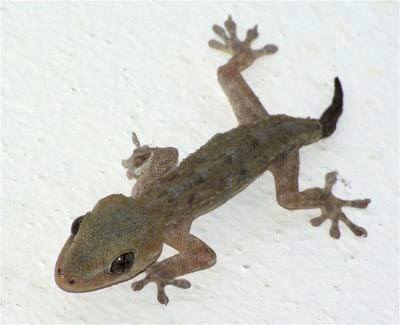
Geckos on La Palma


This is a gecko (Tarentola delalandii). They're quite common in La Palma. You find them in warm buildings or on sunny walls outside, and this one lives in my house. I think he must have got too close to one of my cats because his tail's regrowing. You see, if they're in serious danger of being eaten, their tails come off and provide a wriggling decoy while the gecko runs away.

He spent most of yesterday on this smooth vertical wall. They can walk across ceilings too, like Spiderman. I think he might have been asleep, since he never moved, although it's hard to tell because they don't have eyelids. I rather like to have him around, because they eat insects, including mosquitoes. When they hunt, they stalk the insect slowly until they get close enough, then the tongue flicks out and grabs the unfortunate bug, and that's that.

The really surprising thing about them is their call. It sounds like the chuckle of a mad axe-murderer, which is quite alarming when you're alone in the house and you haven't a clue what it is.

But of course you aren't in any danger at all - unlike the geckos. They're on the red list of threatened species.

Labels: ,

Bookmark with:

Del.icio.us Digg Reddit Facebook Furl It Newsvine StumbleUpon ToolbarStumbleUpon

Monday, 11 October 2010

Ravens on La Palma

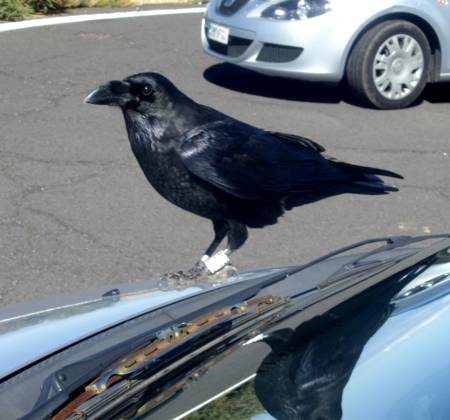
Raven on my car at the observatory, Garafía.Carmelo the raven (Corvus corax canariensis) on my car at the observatory, Garafía.

Common Ravens live all over Europe, Asia and North America, but we have a different sub-species here. Some biologists group our raven in with the North African sub-species (Corvus corax tingitanus) and others think the Canaries have their own sub-species (Corvus corax canariensis).

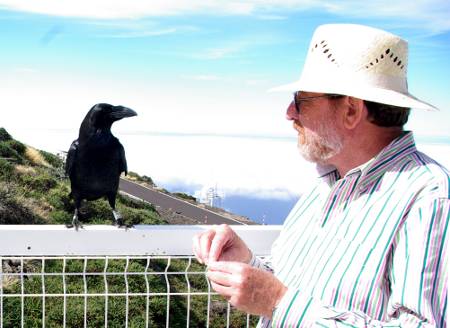
Like other members of the rook-and-crow family, they'll eat whatever's available: carrion, insects, cereal grains, berries, fruit, small animals, and food waste. And they're pretty intelligent about getting it. At least two individual ravens at the Roque have learned to provide a photo opportunity in exchange for some food.


Raven outside the Galileo telescope, Garafía.Raven outside the Galileo telescope, Garafía.

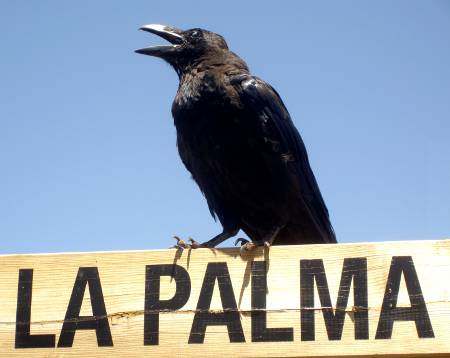
Carmelo hangs around the car park at the Roque itself, although I've met him at the Galileo telescope and observatory heliport. He's got a ring around one ankle. The other raven doesn't have an ankle ring, and I mostly see him near the Los Andennes viewpoint, and I call him Nevermore, after the poem "The Raven" by Edgar Allan Poe. ("Quoth the raven, `Nevermore.' ")

Nevermore, the raven (Corvus corax canariensis) at Los Andennes viewpoint, Garafía.Nevermore, the raven at Los Andennes viewpoint, Garafía.

Labels: , , ,

Bookmark with:

Del.icio.us Digg Reddit Facebook Furl It Newsvine StumbleUpon ToolbarStumbleUpon

Friday, 27 August 2010

What to Feed Lizards on La Palma

A female wall lizard grabbing watermelon, Tedote, La Palma

Yesterday I discovered that the local lizards (Gallotia galloti palmae) are fond on watermelon on a hot day. Figures. Unlike most lizards, they eat quite a lot of plants, especially ripe fruit, to the point where they can become a nuisance in vinyards.

I recently discovered that we only have one species of small lizard here. What I thought were two species is one, with different colours for males and females. The one in the photo above is a female - brown and stripy. The males are greyish, with a blue throat (below.)
Male Palmeran wall lizard, Gallotia galloti palmae

My friend has been told that it’s a big mistake to feed them, as they can loose all fear of humans to the point where they’ll bite your toes. We discussed this, and agreed it seemed unlikely, and if it did happen, it wouldn’t be all that bad. After reading Wikipedia, I conclude that it’s extremely unlikely. Apparently one colony on Teide of the subspecies on Tenerife (Gallotia galloti galloti) has become quite tame and will provide photo opportunities in exchange for ripe banana. There’s no mention of tourists getting their fingers bitten off.

I have to try this. Watch this space.

Labels:

Bookmark with:

Del.icio.us Digg Reddit Facebook Furl It Newsvine StumbleUpon ToolbarStumbleUpon

Tuesday, 3 June 2008

Geckos


This is a gecko (Tarentola delalandii). They like to live in warm buildings or on sunny walls outside, and this one lives in my house. I think he must have got too close to one of my cats because his tail's regrowing. You see, if they're in serious danger of being eaten, their tails come off and provide a wriggling decoy while the gecko runs away.

He spent most of yesterday on this smooth vertical wall. They can walk across ceilings too, like Spiderman. I think he might have been asleep, since he never moved, although it's hard to tell because they don't have eyelids. I rather like to have him around, because they eat insects, including mosquitoes. When they hunt, they stalk the insect slowly until they get close enough, then the tongue flicks out and grabs the unfortunate bug, and that's that.

The really surprising thing about them is their call. It sounds like the chuckle of a mad axe-murderer, which is quite alarming when you're alone in the house and you haven't a clue what it is.

But of course you aren't in any danger at all - unlike the geckos. They're on the red list of threatened species.

Labels: , , , ,

Bookmark with:

Del.icio.us Digg Reddit Facebook Furl It Newsvine StumbleUpon ToolbarStumbleUpon

Wednesday, 7 May 2008

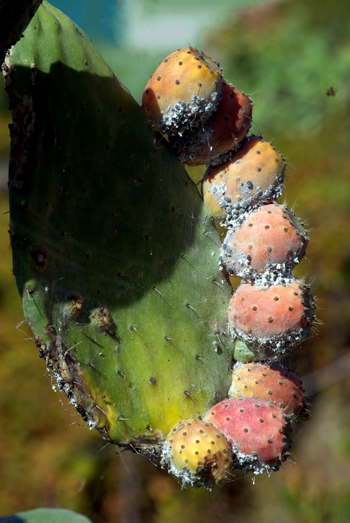
Cochineal and Prickerly Pears


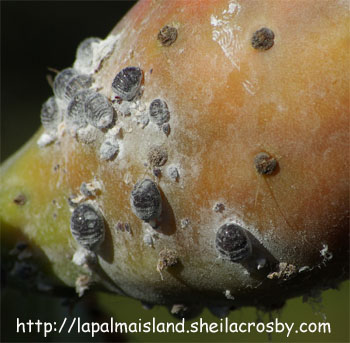
In the 1850s the export market for Palmeran wine collapsed, and somebody had the bright idea of going into cochineal production. Before the advent of synthetic dyes, this was far and away the best red dye available, particularly for wool. For one thing, it doesn't fade.

Cochineal is made from a parasitic insect (Dactylopius coccus), which lives on prickly pears (tuneras), so the plants and insects were imported from Mexico. In this climate, prickly pears grow without needing any special attention. In fact they have a tendency to take over your garden if you don't fight back. The insects thrive on neglect, too.

Peasants collected the pale gray females, which were then dried and ground up to produce the dye. Although collecting the insects was labour intensive, soon it was the mainstay of the island's economy.

And then some rotten so-and-so invented synthetic alizarine dye, which was much cheaper. The bottom fell out of the cochineal market.

There's still a small market for cochineal, because it's safe to use in food and cosmetics. And of course you can eat the prickly pears. They're harvested using giant wooden tongs, and eaten with a knife and fork, to avoid the spines.

Labels: , , , , , , , ,

Bookmark with:

Del.icio.us Digg Reddit Facebook Furl It Newsvine StumbleUpon ToolbarStumbleUpon

Saturday, 16 February 2008

Giant Lizards

Giant Lizard
Photo EFE

Yesterday I clean forgot that in December last year they found out that the giant Canarian lizard, Gallotia auaritae, isn't extinct after all. José Antonio Mateo, a reptile expert, only found the one, but he believes there must be a colony within a kilometre of the one he found. In this case, "giant" means 30 cm (one foot) long. Extinct specimens are larger.

Twenty-five years ago, they thought
Gallotia lizards only survived on Gran Canaria (Gallotia stehlini). Since then, species have been found on several other islands. The ones on La Gomera (Gallotia bravoana) and El Hierro (Gallotia simonyi) grow to a whacking 60 cm long, while the one on Tenerife (Gallotia galloti) grows to 40cm long.

Like so many animals these days, the whole lot are on the endangered list, except for the one on Gran Canaria.

I'd love to go looking for one, but they haven't told the public the location, probably very deliberately. After all, hundreds of tourists trampling all over their habitat probably would send them extinct.

Labels: , , , , , ,

Bookmark with:

Del.icio.us Digg Reddit Facebook Furl It Newsvine StumbleUpon ToolbarStumbleUpon